
What are the skills of AEDP (Accelerated Experiential Dynamic Psychotherapy), and how do you practice them?
AEDP holds that people heal by feeling hard emotions with a trusted other instead of alone. PracticeTherapy.ai has a free AEDP Therapy course with nine skills, and here we'll explain the research behind them.
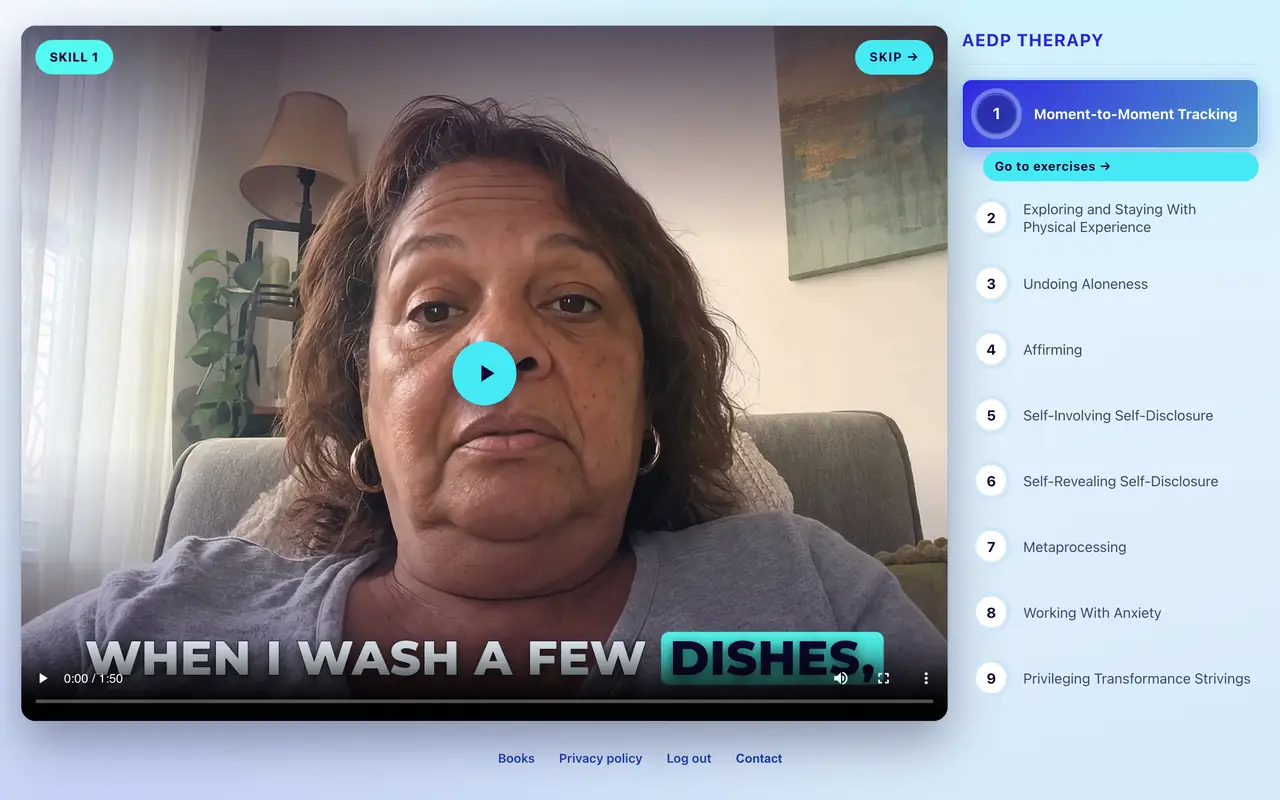
Accelerated Experiential Dynamic Psychotherapy (AEDP) is a psychotherapy that helps clients feel their emotions all the way through, in the body and in the moment, with a therapist who is openly warm, engaged and on their side. The AEDP course on PracticeTherapy.ai trains nine of its core skills, one at a time, in 135 short exercises: a video client says a line, you answer out loud, and an AI voice coach tells you right away whether your answer met the skill's criteria.
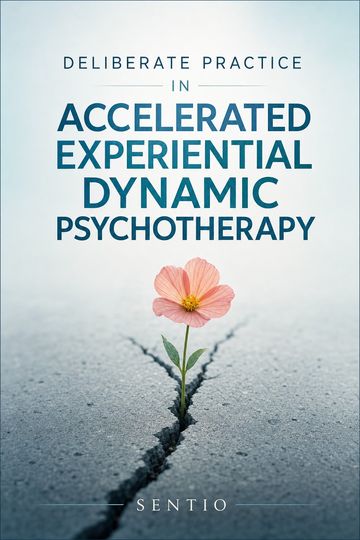
The nine skills come from Deliberate Practice in Accelerated Experiential Dynamic Psychotherapy (Prenn, Levenson, Vaz and Rousmaniere, 2025), one of the American Psychological Association's deliberate practice books: its first eight exercises in order, then its eleventh. AEDP is a private beta course on the site, so it needs an invite code.
- Moment-to-Moment Tracking
- Exploring and Staying With Physical Experience
- Undoing Aloneness
- Affirming
- Self-Involving Self-Disclosure
- Self-Revealing Self-Disclosure
- Metaprocessing
- Working With Anxiety
- Privileging Transformance Strivings
Where does AEDP come from?
AEDP was developed by the psychologist Diana Fosha, who first described it in her 2000 book The Transforming Power of Affect and who founded and directs the AEDP Institute (AEDP Institute, n.d.; Fosha, 2000). AEDP has "its lineage in psychodynamic psychotherapy and the short-term dynamic/experiential psychotherapies" (Prenn and colleagues, 2025), especially those that work with emotion as it arises in the session (Fosha, 2002; Malan, 1979).
What is AEDP built on?
AEDP is integrative by design. Its experiential approach draws on attachment research, emotion theory, developmental models, trauma approaches, body-focused treatments and affective neuroscience (Prenn and colleagues, 2025).
The skills begin with AEDP's view of suffering. AEDP understands psychological problems as the result of "unwilled and unwanted aloneness" in the face of overwhelming emotion (Fosha, 2009): symptoms are a person's best attempts to handle, on their own, feelings that were too much. A child whom no one comforted when sad may learn to "smile and say they're fine or make jokes and avoid their sadness," and may never learn "that they can feel sad, share their tears and sad feelings with another, and receive comfort" (Prenn and colleagues, 2025).
AEDP also holds that everyone has an innate drive to heal, to grow and to be known and connected, which it calls transformance. Its therapists listen for glimmers of it from the very first session (Prenn and colleagues, 2025).
How does AEDP help people change?
By feeling core feelings with someone. Prenn and colleagues (2025) put the premise in one line: "feeling core feelings in the context of a secure attachment with another person is transformational." When clients have "the visceral experience of knowing that there is a supportive, emotionally engaged other with whom to share both suffering and joys," they "can relinquish their reliance on defenses and begin to risk genuine emotional and relational experiencing" (Prenn and colleagues, 2025). One phrase sums up every AEDP intervention, "stay with it and stay with me": stay with your inner experience, and stay with me, your therapist (Prenn and colleagues, 2025).
AEDP has "two fundamental and overlapping maps" for the work, the triangle of experience and the four-state model. The triangle began as David Malan's triangle of conflict (Fosha, 2002; Malan, 1979) and is now "a triangle standing on its point," with defenses and anxiety in the two top corners, and core feelings and core relational experiences at the bottom, where AEDP helps clients go. The four-state model traces this journey: from anxiety and defense (State 1) to core feeling (State 2), then to processing what that change feels like (State 3), and lastly to core state (State 4), a place of ease and clarity typified by "This is me and I am okay" (Prenn and colleagues, 2025).
What is the evidence for AEDP?
It's still young and shows promise. The main outcome study is based on 62 adults who had 16 sessions of AEDP in private practices in the United States, Canada, Israel, Japan and Sweden. It reported "large effect sizes (d > 0.80)" for clinical problems and subjective distress, and "patients maintained their posttreatment therapeutic gains, both 6 and 12 months later" (Iwakabe and colleagues, 2020, 2022).
AEDP is a member of the broader family of experiential dynamic therapies. This family of therapies has 28 randomized controlled trials, in which the therapies have beaten inactive controls with medium effect sizes, and have been comparable to other active treatments (Lilliengren and colleagues, 2016).
Why practice AEDP skills one at a time?
Natasha Prenn, the course book's lead author, kept asking through her own training, "I understand the theory but what do I say and do in session with clients?" (Prenn and colleagues, 2025). The authors write that AEDP's own skills trainings "focus heavily on the actual language of AEDP interventions and on lots of practice saying and doing and experiencing AEDP," in what they call "deliberate practice lite," and that formal deliberate practice "integrates into the existing AEDP training program hand-in-glove" (Prenn and colleagues, 2025).
The course follows this format, with 15 exercises per skill, five each at beginner, intermediate and advanced level, plus three or four worked examples. In many lines, and in every tracking exercise, the client does something with their body as they speak, such as a sigh, a fist on the armrest or a hand on the belly, and the video shows it. In skill practice there are specific criteria, and the question is really "did you meet the clinical criteria" so that's what the voice coach focuses on. It checks a transcript of your spoken answer against one to three criteria per skill, and to pass you have to meet every one that applies. In AEDP "we go slow and drop our voices into low, soothing tones" (Prenn and colleagues, 2025), but the coach hears only your words, so answer the way you would in the room: slowly, warmly and with your body in it.
The article Can you practice therapy skills on your own? describes how an exercise works step by step, and the article What can't an AI coach hear? describes what the coach does and does not judge.
Why do AEDP therapists track the body moment to moment?
Skill 1: Moment-to-Moment Tracking. The course's first criterion is to "briefly point out and describe a nonverbal or body motion that the client makes." There is no interpretation and no question about what it means, only noticing and naming, or "interpersonal mindfulness," in the authors' words (Prenn and colleagues, 2025). When a client says, "Dad and I loved our fishing trip," with a big sigh, the course's model answer is simply "That is a big sigh."
Tracking is "the skill from which all else flows" in AEDP (Prenn and colleagues, 2025). The authors list what to track: "Posture, movement, tension, relaxation, facial expression, shifts in eye contact and gaze direction, speech, tone, volume, pace, congruence, coherence, breathing, and so forth." Clients are "usually unaware that their physical sensations are associated with their emotional reactions," so naming what you see gently brings that experience into the open, and the authors call tracking "a direct route into the implicit" (Prenn and colleagues, 2025). It also shows you where to go next, since it finds the "it" in "stay with it."
The authors call tracking "a deceptively easy-sounding skill," because therapists are trained to attend to words (Prenn and colleagues, 2025). The course labels 4 of its 18 unskilled examples for this skill "Tracks a motion that didn't happen", and others "Names a feeling, not a motion" ("You seem a little shy saying that") or "Reflects the memory, misses the motion". Its second criterion covers the first of these: "Your observation must be loosely shown in the video."
In a real session a therapist "will not name every movement the client makes," but in the exercise "we are isolating one skill and practicing it" (Prenn and colleagues, 2025).
Why ask how a feeling shows up in the body?
Skill 2: Exploring and Staying With Physical Experience. When a client uses a feeling word, you invite them to notice how they experience it physically. When they are already describing a sensation, you ask whether the two of you can stay with it. The course's model answers for the two moves include "Oh . . . what does that grief feel like in your body?" and "Can we stay with that fist squeezing your heart and get to know it?"
"The essence of this skill is to help the client experience where they are," write Prenn and colleagues (2025). Neither you nor the client needs "to try to figure out or have a preconceived idea of what the somatic experience means." Staying with the sensation rather than talking about it deepens the experience and, in the authors' words, "results in more awareness of whatever is coming up inside." Across therapies, a meta-analysis of 10 studies and 406 clients concluded that "Client experiencing is a small to medium predictor of treatment outcomes and a probable common factor," experiencing being how deeply clients process and make sense of what they feel in session (Pascual-Leone and Yeryomenko, 2017).
Of the course's 19 unskilled examples for this skill, 5 are labeled "Non-somatic question", like "Oh, I'm so sorry about your cat. How does that make you feel?" Others are labeled "Explores the story", "Asks why, not the body", "Only reflects", "Doesn't invite" and "Moves past the feeling".
Why does an AEDP therapist make sure the client isn't alone?
Skill 3: Undoing Aloneness. The course's three criteria are to "strengthen your presence with paraverbal and nonverbal cues" (leaning in, a hand to your heart, "mmm," "ouch"), to "say outright, or let your phrasing suggest, that you are present with the client," and to "encourage the client to receive your presence by inviting or asking them." The standard question (Prenn and colleagues, 2025) is "Can you feel me with you?"
If suffering comes from facing too much alone, the remedy is company: "We can do together now what you could not do alone then" (Prenn and colleagues, 2025). In a brain imaging study, 16 married women faced the threat of an electric shock while holding their husband's hand, a stranger's hand or no hand at all, and holding the husband's hand brought "a pervasive attenuation of activation in the neural systems supporting emotional and behavioral threat responses," with "a more limited attenuation" for the stranger's (Coan, Schaefer and Davidson, 2006). In a larger study of 110 participants, "handholding by familiar relational partners attenuates both subjective distress and activity in a network associated with salience, vigilance and regulatory self-control," and "we did not observe any regulatory effects of handholding by strangers" (Coan and colleagues, 2017). The felt closeness is what mattered, which is why AEDP asks rather than assumes: "We do not assume that a client feels our presence; we ask to make it explicit" (Prenn and colleagues, 2025). If the client has difficulty letting your presence in, "you can use that information to focus the work on building the client's receptive affective and relational capacities" (Prenn and colleagues, 2025).
All 18 of the course's unskilled examples for this skill carry a different label, from "Reassures" and "Normalizes instead of being present" to "Looks for other helpers" and "Checks wording, not connection" ("Did I say that the right way?").
In the course, a client says, "Since losing my cat, I feel such grief," and the model answer is "Ohh. My heart breaks with yours. Can you feel me with you right now?"
Why affirm a client in AEDP?
Skill 4: Affirming. The course's criteria are to "genuinely affirm something concrete the client did or is doing" and to "let your body language and vocal prosody (tone) carry the same affirmation as your words." "Affirming is not about being kind or saying nice things" (Prenn and colleagues, 2025); it is noticing something real, often how the client is working in the session rather than what they are talking about, and openly delighting in it. To a client who shut their laptop at six instead of working until midnight, the model answer is "[Smiling broadly] Wow! I am thrilled you shut your laptop at six. What a big change for you!"
AEDP wants therapy to feel good even while it deals with painful material. Affirming builds safety and trust and gives clients confidence that their experiences make sense and that they are doing therapy right (Prenn and colleagues, 2025). Across 64 studies, therapist positive regard had a small positive association with treatment outcome, g = .28 (Farber, Suzuki and Lynch, 2018). In AEDP, affirming "often includes the self-disclosing of the impact of the client's words on the therapist" (Prenn and colleagues, 2025), while Miller and Moyers (2021), writing on Motivational Interviewing, advise starting affirmations with the word "you" rather than "I"; the Motivational Interviewing course practices that other style.
Therapists trained to stay neutral or to look for pathology can be hesitant about being so openly delighted, and open delight "may seem forced or feigned at first; hence, the importance of practicing" (Prenn and colleagues, 2025). Six of the course's 18 unskilled examples for this skill praise the wrong thing, labeled "Praises the husband", "Praises a trait, not the act" and so on, and another, "Pushes for more instead", answers with "Okay. Now try to do that every night this week".
Why tell a client how they are affecting you?
Skill 5: Self-Involving Self-Disclosure. You tell the client, specifically, what they just said or did and what it stirs in you right now, in the format "When I (see, feel, sense) you do X, then I feel Y" (Prenn and colleagues, 2025). To a client who says no one has heard this story before and they want to tell you, the model answer is "When you tell me you want me to know that story, I feel so touched and my chest feels open."
In AEDP's view, this kind of disclosure "can be the quickest way to deepen an experience between two people" (Prenn and colleagues, 2025). It shows clients that they matter to and affect another person, and your openness invites theirs: "disclosure begets disclosure" (Jourard, 1971). In the authors' words, "it is not the self-disclosure skill alone that can create relationship security; it is the client's response to and experience of the self-disclosure," which is why AEDP follows it by asking how it landed (Prenn and colleagues, 2025). In a qualitative meta-analysis of 21 studies, therapist self-disclosure and immediacy, talking openly about the here-and-now relationship, were most often followed by "enhanced therapy relationship, improved client mental health functioning, gains in insight, and overall helpfulness," and immediacy by the client opening up (Hill, Knox and Pinto-Coelho, 2018). Immediacy can, however, feel awkward or pressuring: in one 12-session case, "the client felt somewhat awkward and pressured when the therapist used immediacy" (Kasper, Hill and Kivlighan, 2008), which is one more reason to check.
Four of the course's 18 unskilled examples for this skill are labeled "Gives an opinion, not a feeling", "Calls an opinion a feeling", "States a thought as a feeling" or "Names a thought, not a feeling", like "I think that's probably a good idea". Others are labeled "Vague feeling, no trigger", "Reflects the client's feeling" or "Invites the story instead". Self-disclosure, the authors say, "often makes therapists nervous," since it can feel like breaking a rule of neutrality (Prenn and colleagues, 2025).
When should a therapist share their own experience?
Skill 6: Self-Revealing Self-Disclosure. The course has one criterion for this skill: "Disclose something you yourself have lived through that connects to the most moving or important aspect of the client's words." A disclosure says, in effect, "I know what this is like. The two of us have this in common" (Prenn and colleagues, 2025). To a client ashamed of the pure jealousy they felt seeing photos from a reunion weekend, the model answer is "Oh, that stings. I've felt that type of jealousy too."
The client feels less alone and meets you as a real person. The research is favorable: a meta-analysis of 53 studies found that clients rated counselors who self-disclosed more favorably, especially when the disclosure showed the counselor had been through something similar (Henretty and colleagues, 2014).
AEDP is firm about limits. In real sessions, self-revealing disclosures are used sparingly and always in the client's service, kept general on hot topics such as sex and violence, and never overshared (Prenn and colleagues, 2025). Here you practice the skill over and over, "in the spirit of deliberate practice," far more often than a real session would call for.
The course labels 3 of its 18 unskilled examples for this skill "Imagines instead of sharing", as in "I'm sure I'd feel jealous too if I saw those photos", and 2 more "Shares someone else's story". Others are labeled "Hints, shares nothing lived" and "Connects to a side detail".
Why ask a client how an intervention landed?
Skill 7: Metaprocessing. Right after you do something, you ask what it was like for the client, with real curiosity and no answer in mind: "So what is this like for you right now that I noticed X [or said Y or did Z]?" (Prenn and colleagues, 2025). In the course you pair it with an earlier skill: tracking on beginner lines, affirming on intermediate lines and self-revealing disclosure on advanced ones. To a client biting their nails as they say they feel safe with you, the model answer tracks and then asks: "You're biting your nails as you tell me that. How is it to hear that I noticed that?"
Metaprocessing is "the second intervention in almost everything we do in AEDP," because what matters is how the client experiences each moment of the therapy (Prenn and colleagues, 2025). Metaprocessing "helps keep the therapist and client in sync and on track, together," and the client's answer shows what to do next: "further processing, repair of a rupture, undoing aloneness, affirmation" (Prenn and colleagues, 2025). A rupture might sound like "I felt self-conscious when you noticed I looked away while talking," which the two of you can then repair, and looking openly at what happens between you helps create "portable change," that is, change the client carries into life outside therapy.
Of the course's 18 unskilled examples for this skill, some go in with an agenda, labeled "Asks why, not how it lands", "Asks what they need" and "Makes a plan instead", as in "Could you set a six o'clock reminder so you can stop working on time again?" The first half trips people up too, when they track a change the client never made, which the course labels "Tracks a change that didn't happen".
Why doesn't an AEDP therapist calm anxiety right away?
Skill 8: Working With Anxiety. You recast the client's anxiety, whatever form it takes, as something good, a sign that something important is coming up, and you ask their consent to turn toward it together. To a client whose hands just went ice cold, the model answer is "Hmm. Your hands might be trying to tell us something important right now, going ice cold like that. Would it be okay with you if we listened together to what they might be saying?"
In AEDP, anxiety indicates that the person is close to something important, so the therapist keeps a "foot on the gas pedal of anxiety" instead of soothing it away (Prenn and colleagues, 2025). Prenn, the lead author, learned this the hard way. Early on, she quickly soothed anxious clients for fear of hurting them, and they stayed calm and far from their core feelings. When a client is clearly overwhelmed, you calm things first, with presence, disclosure and affirmation. While they stay within their window of tolerance, the range of arousal in which they can still function and take in experience, you keep going (Siegel, 1999; Prenn and colleagues, 2025).
Reframing anxiety has support outside therapy. In studies of karaoke singing, public speaking and math performance, "individuals who reappraise their anxious arousal as excitement feel more excited and perform better" than those who attempt to calm down (Brooks, 2014). Among 60 people with anxiety and mood disorders who watched an emotion-provoking film, "the acceptance group displayed less negative affect during the post-film recovery period" than the suppression group (Campbell-Sills and colleagues, 2006).
The course's unskilled answer to the client with ice-cold hands is "Can we do some breathing to warm your hands back up?" It is kind, and it turns away from the anxiety instead of toward it, the very mistake Prenn describes, and the course labels it "Asks to make it go away". Other labels are "Treats it as a problem", "Calls it normal, not good", "Looks for a cause" and "Doesn't ask consent".
Why do AEDP therapists look for what is going right?
Skill 9: Privileging Transformance Strivings. The course's two criteria are to "watch and listen for chances to highlight something healthier in what the client says or does" and to "apply an AEDP skill taught here to celebrate, encourage, or reinforce that healthier behavior." To a client who plans to talk to the head chef who keeps singling them out, one model answer is "I really admire that you're choosing to stand up for yourself."
AEDP therapists are "transformance detectives" (Prenn and colleagues, 2025). They look for glimmers of transformance, the drive to heal and grow that AEDP sees as the counterpart of resistance, and make those glimmers bigger. The evidence is encouraging: a meta-analysis of 9 trials found "a small but significant effect in favor of strength-based bona fide psychotherapies" over other well-established therapies, g = 0.17 (Flückiger and colleagues, 2023).
The course labels the unskilled answers "Reflects the problem" ("It sounds really frustrating that the head chef keeps singling you out like that"), "Doubts the change", "Credits the therapist, not the client" and "Skips to the next goal". Any skill can be the response, so all 18 of the course's model answers for this skill list two or three options joined by "or", and the authors say you "might challenge yourself by trying less used skills, particularly as you progress to the advanced statements" (Prenn and colleagues, 2025).
 Private beta
AEDP Therapy
Nine skills for helping clients feel hard emotions with a trusted other instead of alone, practiced out loud with an AI voice coach.
About the author

Sources
- AEDP Institute. (n.d.). Diana Fosha, PhD. Retrieved November 3, 2026, from https://aedpinstitute.org/diana-fosha/
- Brooks, A. W. (2014). Get excited: Reappraising pre-performance anxiety as excitement. Journal of Experimental Psychology: General, 143(3), 1144-1158. https://doi.org/10.1037/a0035325
- Campbell-Sills, L., Barlow, D. H., Brown, T. A., & Hofmann, S. G. (2006). Effects of suppression and acceptance on emotional responses of individuals with anxiety and mood disorders. Behaviour Research and Therapy, 44(9), 1251-1263. https://doi.org/10.1016/j.brat.2005.10.001
- Coan, J. A., Beckes, L., Gonzalez, M. Z., Maresh, E. L., Brown, C. L., & Hasselmo, K. (2017). Relationship status and perceived support in the social regulation of neural responses to threat. Social Cognitive and Affective Neuroscience, 12(10), 1574-1583. https://doi.org/10.1093/scan/nsx091
- Coan, J. A., Schaefer, H. S., & Davidson, R. J. (2006). Lending a hand: Social regulation of the neural response to threat. Psychological Science, 17(12), 1032-1039. https://doi.org/10.1111/j.1467-9280.2006.01832.x
- Farber, B. A., Suzuki, J. Y., & Lynch, D. A. (2018). Positive regard and psychotherapy outcome: A meta-analytic review. Psychotherapy, 55(4), 411-423. https://doi.org/10.1037/pst0000171
- Flückiger, C., Munder, T., Del Re, A. C., & Solomonov, N. (2023). Strength-based methods: A narrative review and comparative multilevel meta-analysis of positive interventions in clinical settings. Psychotherapy Research, 33(7), 856-872. https://doi.org/10.1080/10503307.2023.2181718
- Fosha, D. (2000). The transforming power of affect: A model for accelerated change. Basic Books.
- Fosha, D. (2002). The activation of affective change processes in accelerated experiential-dynamic psychotherapy (AEDP). In J. J. Magnavita (Ed.), Comprehensive handbook of psychotherapy: Vol. 1. Psychodynamic and object relations psychotherapies (pp. 309-344). John Wiley & Sons.
- Fosha, D. (2009). Emotion and recognition at work: Energy, vitality, pleasure, truth, desire, and the emergent phenomenology of transformational experience. In D. Fosha, D. J. Siegel, & M. F. Solomon (Eds.), The healing power of emotion: Affective neuroscience, development, & clinical practice (pp. 173-203). W. W. Norton & Company.
- Henretty, J. R., Currier, J. M., Berman, J. S., & Levitt, H. M. (2014). The impact of counselor self-disclosure on clients: A meta-analytic review of experimental and quasi-experimental research. Journal of Counseling Psychology, 61(2), 191-207. https://doi.org/10.1037/a0036189
- Hill, C. E., Knox, S., & Pinto-Coelho, K. G. (2018). Therapist self-disclosure and immediacy: A qualitative meta-analysis. Psychotherapy, 55(4), 445-460. https://doi.org/10.1037/pst0000182
- Iwakabe, S., Edlin, J., Fosha, D., Gretton, H., Joseph, A. J., Nunnink, S. E., Nakamura, K., & Thoma, N. C. (2020). The effectiveness of accelerated experiential dynamic psychotherapy (AEDP) in private practice settings: A transdiagnostic study conducted within the context of a practice-research network. Psychotherapy, 57(4), 548-561. https://doi.org/10.1037/pst0000344
- Iwakabe, S., Edlin, J., Fosha, D., Thoma, N. C., Gretton, H., Joseph, A. J., & Nakamura, K. (2022). The long-term outcome of accelerated experiential dynamic psychotherapy: 6- and 12-month follow-up results. Psychotherapy, 59(3), 431-446. https://doi.org/10.1037/pst0000441
- Jourard, S. M. (1971). The transparent self. Van Nostrand.
- Kasper, L. B., Hill, C. E., & Kivlighan, D. M. (2008). Therapist immediacy in brief psychotherapy: Case study I. Psychotherapy: Theory, Research, Practice, Training, 45(3), 281-297. https://doi.org/10.1037/a0013305
- Lilliengren, P., Johansson, R., Lindqvist, K., Mechler, J., & Andersson, G. (2016). Efficacy of experiential dynamic therapy for psychiatric conditions: A meta-analysis of randomized controlled trials. Psychotherapy, 53(1), 90-104. https://doi.org/10.1037/pst0000024
- Malan, D. H. (1979). Individual psychotherapy and the science of psychodynamics. Butterworths.
- Miller, W. R., & Moyers, T. B. (2021). Effective psychotherapists: Clinical skills that improve client outcomes. Guilford Press.
- Pascual-Leone, A., & Yeryomenko, N. (2017). The client "experiencing" scale as a predictor of treatment outcomes: A meta-analysis on psychotherapy process. Psychotherapy Research, 27(6), 653-665. https://doi.org/10.1080/10503307.2016.1152409
- Prenn, N. C. N., Levenson, H., Vaz, A., & Rousmaniere, T. (2025). Deliberate practice in accelerated experiential dynamic psychotherapy. American Psychological Association. https://doi.org/10.1037/0000439-000
- Siegel, D. J. (1999). The developing mind: Toward a neurobiology of interpersonal experience. Guilford Press.