
What are facilitative interpersonal skills, and how do you practice them?
Facilitative interpersonal skills set more effective therapists apart. PracticeTherapy.ai has a free Facilitative Interpersonal Skills course with eleven skills, and here we'll explain the research behind them.
Facilitative interpersonal skills (FIS) are the relational skills that set more effective therapists apart, whatever model they practice. Timothy Anderson's research group defined eight of them: empathy; warmth, acceptance and understanding; emotional expression; verbal fluency; hope and positive expectations; persuasiveness; alliance-bond capacity; and alliance rupture-repair responsiveness (Anderson and Patterson, 2013). Therapists' scores on these skills predict how much their clients improve (Anderson and colleagues, 2009). The Facilitative Interpersonal Skills course on PracticeTherapy.ai trains all eight, plus three skills for deepening a client's emotional experience, in 165 exercises. You watch a short video of a client, answer out loud, and an AI voice coach tells you right away whether your answer met the skill's criteria.
The course is expert-authored material by Daniel Sousa of ISPA, Instituto Universitário, in Lisbon, written in European Portuguese with an English translation, and the site offers it in both languages. It is in private beta, so you need an invite code.
The eleven skills, in course order:
- Empathic Understanding
- Warmth, Acceptance and Understanding
- Emotional Expression
- Verbal Fluency
- Hope and Positive Expectations
- Persuasiveness
- Alliance Bond Capacity
- Alliance Rupture Repair
- Deepening From Event to Feeling
- Deepening By Sitting with Feelings
- Deepening By Following What Emerges
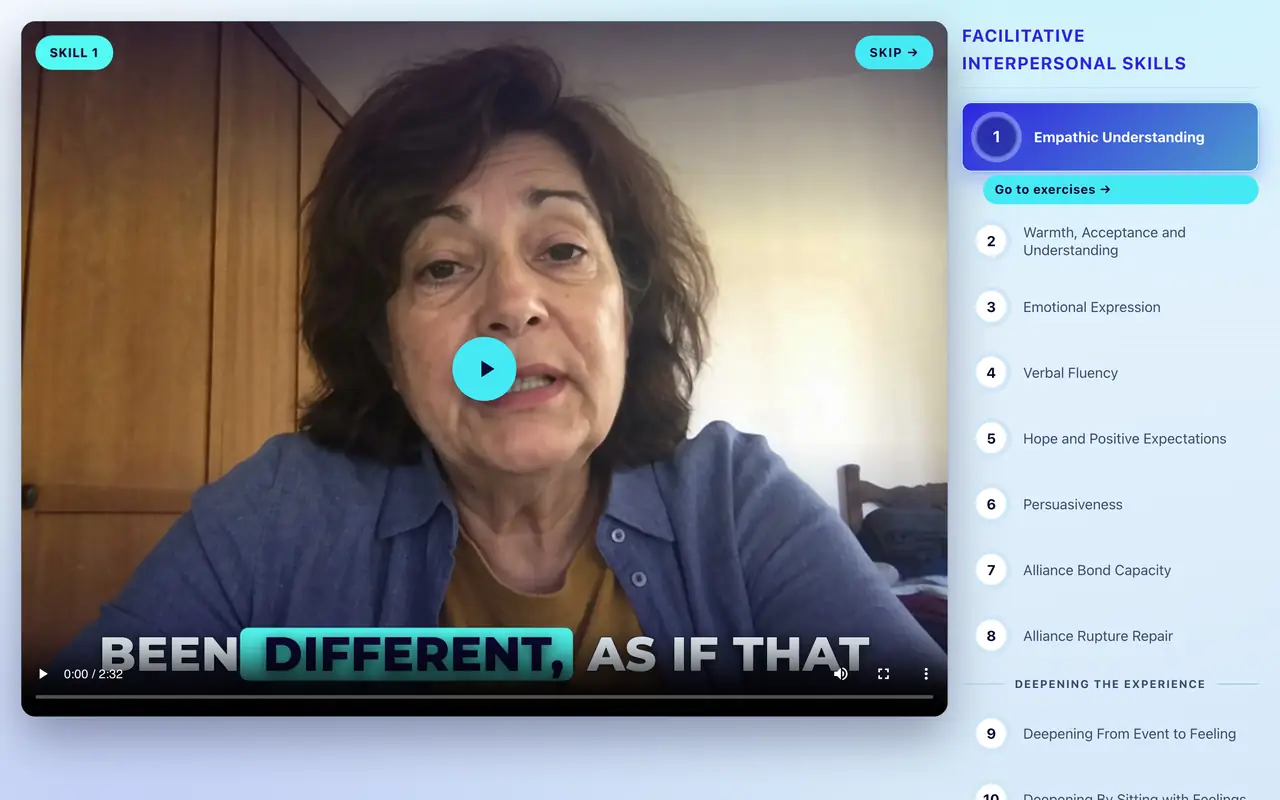
Skills 9 to 11 form the course's section called Deepening the Experience.
How are facilitative interpersonal skills measured?
Anderson and colleagues (2009) describe the FIS performance task as "a performance task that measures therapists' interpersonal skills by rating therapist responses to video simulations of challenging client-therapist interactions": a therapist watches short videos of clients at hard moments in therapy, such as a client attacking the therapist or a client who withdraws, and answers each one aloud as if in session, much as the course practices the skills. Trained coders rate the recorded answers on the eight skills, each on a scale from 1 (not characteristic) to 5 (extremely characteristic) (Bate and Tsakas, 2022).
What is the evidence?
In a university counseling center with 25 therapists and 1,141 clients, Anderson's group compared therapists' age, self-reported social skills and FIS scores, and "only FIS accounted for variance in outcomes" (Anderson and colleagues, 2009). In a prospective study, 44 clinical psychology trainees completed the FIS task "in the initial weeks of their training", and "therapist FIS significantly predicted client symptom change" in therapy that began more than a year later (Anderson, McClintock and colleagues, 2016). Outside Anderson's group, postgraduate trainees with better interpersonal skills at the start had better client outcomes across five years (Schöttke and colleagues, 2017), and in this research years of experience and theoretical orientation do not predict outcomes the way these skills do (Miller and Moyers, 2021).
The skills can be trained, but the gains so far are modest: in a trial with 101 undergraduates, "FIS for Modeled Practice was significantly higher than controls in postpractice", with the modeled-practice group watching model responses and then repeatedly practicing different responses while the controls watched nontherapeutic videos (Anderson, Perlman and colleagues, 2020). In a trial with 58 graduate trainees and therapists, a workshop that combined alliance-focused and FIS training, with video simulations, role plays and deliberate practice, produced "a marginally higher post-intervention level of overall therapeutic skills" than a traditional demonstration workshop, but exploratory analyses found "significantly higher levels" of empathy, alliance bond capacity and alliance rupture-repair responsiveness (Perlman and colleagues, 2020). With 68 experienced therapists, a two-day deliberate practice workshop plus two booster sessions brought "significant within-group improvement" in one group (g = .42) and "a small, non-significant improvement" in the other (g = .21), and "the largest gains" were in alliance bond capacity and rupture-repair responsiveness (Fagerbakk and colleagues, 2026).
Where does the course come from?
Daniel Sousa wrote it. Most of its first eight chapters adapt exercises from Treino em Psicoterapia, a Portuguese deliberate practice manual by Alexandre Vaz, Daniel Sousa and Margarida Afonseca, with a preface by Bruce Wampold (Vaz and colleagues, 2023). Emotional Expression and Verbal Fluency were written for this course, and the three deepening skills are built on the Therapist Experiencing Scale (Sousa, 2026). Sousa and Vaz also co-wrote a 2021 paper on persuasiveness as an underappreciated trait of effective therapists (Vaz and Sousa, 2021), which this article draws on throughout.
Sousa wrote the material for video. "The criteria are assessed from what is heard and seen, not from the written form of a response", and at the advanced level a client whose face or voice contradicts their words can only be read by seeing and hearing them (Sousa, 2026). Most skills also list a delivery criterion, such as "Speak in a warm, accepting tone", which appears on the exercise screen for the therapist to practice in their own voice, while the coach, which reads a transcript of their words, checks the other criteria. For skills 2 to 8, Sousa wrote those criteria "for the voice coach: short, explicit, and checkable from the transcript", and each of them includes "Keep it short: three sentences at most."
Each skill has 15 exercises, 5 at each level (beginner, intermediate and advanced), plus worked examples, and an answer passes only when it meets every scored criterion; how a round works, step by step, is in Can you practice therapy skills on your own?, and the research behind the method is in What is deliberate practice for therapists?.
Why offer empathic understanding?
Empathic Understanding, the first skill, reflects in your own words the main emotions or meanings in what the client said, in an exploratory, tentative tone, without asking questions, making suggestions or interpreting the client's experience.
Sousa calls it "the most basic therapist response mode and the one used most frequently throughout the whole course of therapy" (Sousa, 2026). Empathy is linked to better outcomes across 82 samples and 6,138 clients (r = .28; Elliott and colleagues, 2018). For the client, Sousa adds, the use of empathic responses "encourages clients to elaborate on their experience, to unpack important meanings, and to reflect on the impact those meanings have on them".
Sousa lists what makes the tone right: "the pace is slow, with pauses, and the volume is moderate or low", "the intonation falls or is left suspended at the end, offering the understanding rather than closing it", "the response is brief, between five and fifteen seconds, and the therapist falls silent at the end, returning the floor to the client", tentative phrasing such as "it's as if...", "it sounds like..." or "perhaps...", and a face that matches the client's feeling (Sousa, 2026). In the course's example, a client says, "when my cat died, it really hit me hard", and the model answer is "You went through a very painful, sad loss... Your cat meant so much to you... And it feels like that loss is still unfinished..."
The course labels one unskilled answer "Problem-solved": "Have you thought about adopting another cat? A new pet can really help with the grief." Another is labeled "Paraphrased the facts": "So the past few days have been different, and you want to start making some changes." Advising and paraphrasing only the facts are two of the errors Sousa says trainees make most often, and the others are asking instead of reflecting, reassuring, normalizing, interpreting or explaining, "naming an emotion that is not in the utterance, introducing the therapist's own experience, and using a categorical tone" (Sousa, 2026). At the advanced level, Sousa says, reflecting the verbal content and ignoring "the emotion that the client's voice, face, or body contradicts" is "the characteristic failure" (Sousa, 2026).
Why convey warmth, acceptance and understanding?
Warmth, Acceptance and Understanding is the second skill, and the chapter says effective therapists communicate acceptance actively, "validating what is valid without approving what causes harm" (Sousa, 2026). The criteria include "Name the client's experience: the emotion, thought or action they describe", "Say why it makes sense, given the client's situation or history", "Do not approve actions that harm the client or others" and "Do not give advice, reassure, explain causes, or argue with the client".
Acceptance "diminishes defensiveness and makes it safer to consider what is potentially threatening or difficult" (Miller and Moyers, 2021). For the client, hearing that a reaction makes sense carries "a message that is often at odds with client's demoralizing meanings" (Vaz and Sousa, 2021).
The course labels two of its unskilled examples "Approved the drug use" and "Approved the outburst". To "I yelled at my son over something small... I'm not like that, but lately I'm always on edge", the model answer is "You feel ashamed of yelling at him... and it makes sense: you've been on edge for a long time, and when we're like that, small things weigh a lot more."
Sousa's notes count 11 of the course's 18 unskilled responses for this skill as failing "Do not give advice, reassure, explain causes, or argue with the client", 8 as failing "Name the client's experience" and 5 as failing "Say why it makes sense", and one response can fail several. Its labels include "Named it, didn't say why" (three responses) and, for "Don't worry, all parents lose their patience sometimes", "Reassured and normalized".
Why express your own emotional reaction?
Emotional Expression is the third skill, written for this course. In Sousa's words, "the therapist lets the client hear their own emotional reaction to what was said, then brings the focus back to the client". The criteria include "Express your own reaction with a feeling word", "Link your reaction to something specific the client said" and "Do not give advice, reassure, explain, or evaluate". In the course's example, the client got the call last night after eight months of interviews and says, "I got the job!" The model answer is "I'm really glad... eight months of waiting, and finally that call. What's it like for you, letting yourself believe it?"
Sousa writes that "Effective therapists don't speak in a flat or detached way: their words carry genuine interest and emotional presence, adjusted to the client's state" (Sousa, 2026), and Dames and colleagues (2024) say that sharing the feeling a client's words stirred "communicates that they are seen and heard". In a meta-analysis of 13 studies, "a significant medium effect size was found between the therapist's emotional expression and outcomes (d = 0.56)" (Peluso and Freund, 2018).
Miller and Moyers (2021) draw a line: "An excess of transparency can be detrimental". After all, counselors are not co-clients. A disclosure should only be made when there is a reason to believe it will help the client.
Sousa's notes count 11 of the course's 18 unskilled responses for this skill as slipping into advice or reassurance and 9 as having no feeling word. They count 6 as never bringing the focus back. Its labels include "No feeling, jumped to planning", "Spoke of own experience", "Took credit for the therapy" and "Celebrated, missed the hurt".
Why does verbal fluency matter in therapy?
Verbal Fluency is the fourth skill. The criteria are to "answer the client's question directly in your first sentence", "make one main point", "use plain words, without technical terms" and "end by checking that it makes sense to the client or by linking it to their situation".
Effective therapists "answer questions directly, in words the client can use" (Sousa, 2026). Clients ask real questions, such as how long this will take or whether it is confidential. In the first worked example of the Verbal Fluency skill in the course the client (in therapy for the first time) asks: "What actually happens in these sessions?" The model answer states that they talk every week about what has been hard for the client and they try to understand this together and find out what helps. It finishes by asking the client if this makes sense as a start.
Verbal fluency is "the ability to communicate clearly and briefly, adapting what you say to the client in front of you" (Sousa, 2026). Verbal fluency is one of eight skills that, when measured together, predict better outcomes (Anderson and colleagues, 2009).
"Prolonged downloads of information" are what Miller and Moyers (2021) advise against, suggesting instead "bite-sized chunks" and checking in, for example with "Does that make sense to you?"
The course labels 3 of the 18 unskilled examples "Delayed the answer" and 3 "Didn't check in at the end", and one of the others "Used technical terms": "In sessions we do a psychological assessment and a case formulation, and then we set therapeutic goals and evidence-based interventions. Does that make sense as a start?" Another is labeled "Praised the question first".
Why foster hope and positive expectations?
The fifth skill, Hope and Positive Expectations, acknowledges the client's difficulty, names a specific strength, value or resource that shows in what the client said, and links it to what can help now or invites them to say more, without denying the problem, promising results or offering advice.
Clients who expect more from therapy at the start tend to do better. Across 81 samples and 12,722 patients, early outcome expectations correlated r = .18 with outcomes (Constantino, Vîslă and colleagues, 2018). Sousa's route to hope is to reflect the strengths a client already shows, without denying their suffering, so that a demoralized client can see themselves as someone with agency (Sousa, 2026).
For the client, the therapist's hope can stand in until their own returns: "Sometimes when clients lack hope, you can lend them some of yours" (Miller and Moyers, 2021). Naming a strength also points the client to an enduring quality they can use in other situations (Miller and Moyers, 2021).
Overzealous attempts to instill hope can clash with a client's view and damage the therapist's credibility (Miller and Moyers, 2021), and the course's delivery criterion is "Sound warm and sincere, not cheerful." To "I argued with my dad again. This time I left the room before I started yelling, but I stewed on it all night. I don't know if that counts for anything", the model answer is "You stewed on it all night, and that's hard, but this time you managed to leave before yelling. That counts: it shows you already have a way to stop the anger. How did you manage it?"
Sousa's notes count 6 of the course's 18 unskilled responses for this skill as denying the problem, promising or advising, 6 as naming a strength without linking it to what helps, 5 as skipping the difficulty and 5 as naming no specific strength. One of them, labeled "Promised a result", says "You'll see, if you keep this up, the arguments with your dad will stop."
Why does persuasiveness matter in therapy?
Persuasiveness, the sixth skill, acknowledges the client's question, doubt or concern in the first sentence. It then explains how therapy can help with what the client brings, uses the client's own words or example, and ends with a question about what they think, in plain words.
Across 24 samples, patients who found their treatment more credible early on had better outcomes, r = .12 (Constantino, Coyne and colleagues, 2018). One study co-authored by Sousa found that a therapist's persuasiveness at the start of a session "impacts the working alliance at all moments of the session" (Sequeira and colleagues, 2024).
Confusing distress becomes something understandable and changeable for the client when it is explained well. People have "a hardwired need to make sense" of their world and their inner experience (Vaz and Sousa, 2021).
Sousa writes that effective therapists, when they explain how therapy will help, "build this rationale with the client, starting from the client's doubts and words" (Sousa, 2026). Pushing backfires, because advising or persuading clients toward change "tends to elicit psychological reactance" (Miller and Moyers, 2021), which is why the answer ends with a question. To "My doctor says my back pain has to do with stress. But the pain is real, it's not in my head. How is talking to you going to fix that?", the model answer is "The pain is real, and I can see why it bothers you to hear it's in your head. Stress and pain feed each other, and here we'd work on the stress side so the pain has less fuel. How does that sound to you?"
Sousa's notes count 9 of the course's 18 unskilled responses for this skill as never explaining how therapy can help, 5 as skipping the doubt, 4 as ignoring the client's words, 4 as ending without a question and 3 as using technical terms. The course labels one of them "Used technical terms": "Chronic pain has a biopsychosocial component, and regulating the stress axis reduces central sensitization." Vaz and Sousa (2021) warn trainees that "knowledge of and belief in any given rationale does not necessarily translate into their ability to deliver said rationale in a cogent, charismatic manner".
Why build a collaborative bond?
Alliance Bond Capacity, the seventh skill, reflects what the client feels or wants and proposes working on it together, with words like "we", "let's" or "together". It asks for the client's view or invites them to decide, without setting the goal for them or telling them what to do.
The working alliance, the bond plus agreement on goals and tasks, is "one of the most robust predictors of treatment outcomes across therapy modalities" (Vaz and Sousa, 2021): across 295 studies and more than 30,000 patients it correlated r = .278 with outcome (Flückiger and colleagues, 2018). Agreement on goals correlated r = .24 across 54 studies, and collaboration r = .29 across 53 (Tryon and colleagues, 2018).
Collaboration makes the client a partner rather than a patient. Shared goals give therapy a roadmap, because "it is difficult to navigate the journey when one does not know the destination" (Boswell and Constantino, 2022), and a goal is not shared until the client agrees with it (Miller and Moyers, 2021).
Sousa describes the skill as taking "what the client wants and feels as the starting point" and inviting them to decide, "with the therapist, what the work will focus on" (Sousa, 2026). A client says, "I want to change jobs, but I also want to stay close to my parents, they're getting older. I don't know which of these should be the goal." The model answer is "You feel torn between wanting a change and wanting to be close to them... we can look at both together. Which one feels more urgent to work on right now?"
Sousa's notes count 10 of the course's 18 unskilled responses for this skill as never asking the client's view and 9 as setting the goal or giving directions. The course labels one "Picked the goal for him": "You feel torn between changing jobs and staying close to your parents. Since your parents are getting older, it's best we start there."
Why repair alliance ruptures openly?
Alliance Rupture Repair is the eighth skill, and Sousa sums it up this way: "The skill is to welcome the criticism, own your part, and explore what happened between you" (Sousa, 2026). The criteria are to "thank the client or say you appreciate being told", "name the client's dissatisfaction or criticism directly", "if the client points to something you did, own it, without defending or justifying yourself" and "ask the client to say more about what happened between the two of you".
A rupture is "a deterioration in the therapeutic alliance", seen as disagreement on goals, poor collaboration on tasks or a strain in the bond (Eubanks and colleagues, 2018). Ruptures "are common, and how the therapist responds matters" (Sousa, 2026). Across 11 studies and 1,314 patients, rupture resolution showed "a moderate relation" with "positive patient outcome" (r = .29; Eubanks and colleagues, 2018).
Rhodes and colleagues (1994) asked clients to recall being misunderstood in therapy. Repair typically followed "clients' willingness to assert negative feelings about being misunderstood" and therapists facilitating "a mutual repair effort through maintaining a flexible and accepting stance"; when therapists would not discuss those feelings, clients often quit.
The thanks matters because confronting a therapist is a risk many clients avoid, often "being reluctant to confront because of fear of losing the relationship" (Boswell and Constantino, 2022). Thanking fits the "flexible and accepting stance" in Rhodes and colleagues' findings. To "Last week you forgot I had my job interview. It made me wonder if you remember what I tell you", the model answer is "Thank you for telling me this. I forgot something that mattered a lot to you, and I'm sorry. What was it like for you to realize I'd forgotten?"
Sousa's notes count 8 of the course's 18 unskilled responses for this skill as failing "if the client points to something you did, own it, without defending or justifying yourself", 5 as failing "ask the client to say more about what happened between the two of you", 4 as failing "name the client's dissatisfaction or criticism directly" and 3 as failing "thank the client or say you appreciate being told". The course labels the answer to the forgotten interview "Justified the lapse": "Thanks for telling me. I forgot because I had a really busy week, with lots of clients. How did the interview go?"
What is the Deepening the Experience section?
The last three skills rest on the Experiencing Scales (Klein and colleagues, 1986): a client scale that rates how deeply a client engages their own inner experience, and a companion Therapist Experiencing Scale that, in Sousa's words, "assesses the extent to which the therapist is engaged in the client's experiencing". Each skill targets one stage of that scale, one step beyond where the client is: "feelings and inner perspective" in the ninth skill, "the feeling opened up as something to explore" in the tenth, and "what is emerging or shifting now" in the eleventh (Sousa, 2026).
The evidence is strongest on the client side. Across 10 studies and 406 clients, deeper client experiencing in session predicted more symptom improvement, a small to medium effect, and the authors call experiencing "a probable common factor" (Pascual-Leone and Yeryomenko, 2017). The therapist's next response shapes the client's next turn: in sessions with expert therapists, "reflections and acknowledgments, affiliative and noncontrolling interventions" were associated with maintained high experiencing, while "lengthier interventions and interventions rated as affiliative but moderately controlling" were associated with shifts to low experiencing, as were questions in cognitive behavioral sessions (Wiser and Goldfried, 1998). Sousa's self-check for all three skills: if "feel" can be replaced by "think" without loss of meaning, the response is still talking about events (Sousa, 2026).
Why move a client from the event to the feeling?
Deepening From Event to Feeling, the ninth skill, names the client's emotion vividly, directly or with an image (or the one heard in their tone, if they name none). It then says more about the emotion than the client did, without asking about facts, advising, reassuring, explaining causes or evaluating.
Its target is the client who "tells events, and the feeling is named only in passing or shows only in the voice" (Sousa, 2026). The response moves to the next stage, where, in Sousa's words, "the client's feelings and inner perspective become the subject; the event stays as context". Vivid language helps: the American Psychological Association's deliberate practice book on emotion-focused therapy evokes emotion with "vivid imagery, elaborate description, analogy, or metaphor" (Goldman and colleagues, 2021).
Sousa asks the therapist to speak "from the client's perspective as if it were their own, possibly bringing in what they would feel in the client's place" (Sousa, 2026). To "My grandmother died last month. She's the one who raised me. I've been sad, but life goes on, right?", the model answer is "She's the one who raised you... and losing her has left a sadness that's still very much with you, however much life goes on..."
"Named it, added nothing" is the label on 7 of the course's 18 unskilled examples for this skill, like "You're sad because your grandmother died." Others are labeled "Interpreted from outside", "Stayed with the event" and "Reassured, missed the fear". An interviewer's tone, interested only in content, misses even when the words are right (Sousa, 2026).
Why invite a client to sit with a feeling?
Deepening By Sitting with Feelings, the tenth skill, vividly names the emotion the client describes, then tentatively invites them to stay with it and notice it, or asks what else is in it, without telling them what they feel.
To "I've felt such sadness since he left. It's a weight right here in my chest that won't let go of me," the model answer is "A weight in your chest that won't let go... is it only sadness, or is there something else mixed in there?"
Naming a feeling is not the same as exploring it. Here the client already describes what they feel, and the therapist "opens that feeling as something to explore", ideally by inviting the client to stay with it and feel it from the inside rather than explaining it (Sousa, 2026). For the client, staying with a feeling lets them find more in it than they could say at first. They can find a second feeling mixed in, what it is about, what it needs.
The therapist says less than in the previous skill, leaves pauses, invites rather than asserts, and "is no surer than the client" (Sousa, 2026). Unlike in Empathic Understanding, a question can be the skill here, if it widens the feeling rather than asking for facts.
Beginners mirror the feeling without opening it, or open it by explaining or interpreting it. Sousa notes that "the most frequent discrepancy is trainees believing they opened or deepened the process when they actually stayed where the client was" (Sousa, 2026). "Relief and anger at the same time... and when does he usually apologize? Does it happen often?" turns to facts. Other misses in the course say what lies underneath with certainty or give orders instead of inviting.
Why follow what emerges in the moment?
Deepening By Following What Emerges is the eleventh skill, and Sousa describes it this way: "Something is emerging or shifting in the client as they speak." He adds that "The therapist points to it in the present moment and may confirm it with what they feel." The first criterion is "Name what the client is experiencing right now, as they speak." The second is "If the client only reports a change, invite them to feel it now, without saying it is happening. If the client pulls back, name the pulling back; do not push them to go back." The fourth is "Mention your own feeling only to confirm the client's experience."
To "I don't know what this is", said after a silence of several seconds with eyes filling with tears, the model answer is "Something is arriving now... it doesn't have a name yet, but it's there, in your eyes, in your breathing... stay with it for a moment... I'm here with you..."
Following What Emerges means paying close attention to "The client's emerging feelings and their impact", and the therapist's presence conveys "that what is new for the client is new for them too" (Sousa, 2026). As a result, a new feeling gets lived and shared rather than noted and passed over. A therapist offering what is arising in their own body in response "underscores that the client is not alone" (Dames and colleagues, 2024).
At this level, Sousa writes, "video is indispensable, because what is emerging can only be perceived by seeing and hearing the client".
The course labels 2 of its 18 unskilled examples for this skill "Confirmed a reported change", and others "Reflected the conclusion only", "Asked for information", "Forced a return" and "Pushed back to the hurt".
 Private beta
Facilitative Interpersonal Skills
The eight facilitative interpersonal skills, plus three for deepening a client's emotional experience, practiced out loud with an AI voice coach.
About the author

Sources
- Anderson, T., Ogles, B. M., Patterson, C. L., Lambert, M. J., & Vermeersch, D. A. (2009). Therapist effects: Facilitative interpersonal skills as a predictor of therapist success. Journal of Clinical Psychology, 65(7), 755-768. https://doi.org/10.1002/jclp.20583
- Anderson, T., & Patterson, C. (2013). Facilitative interpersonal skill task and rating method. Ohio University. Unpublished rating manual.
- Vaz, A., & Sousa, D. (2021). Persuasiveness: An underappreciated characteristic of effective therapists. Psychology of Consciousness: Theory, Research, and Practice. https://doi.org/10.1037/cns0000309
- Bate, J., & Tsakas, A. (2022). Facilitative interpersonal skills are relevant in child therapy too, so why don't we measure them? Research in Psychotherapy: Psychopathology, Process and Outcome, 25(1), Article 595. https://doi.org/10.4081/ripppo.2022.595
- Boswell, J. F., & Constantino, M. J. (2022). Deliberate practice in cognitive behavioral therapy. American Psychological Association. https://doi.org/10.1037/0000256-000 (cited for its exercises on goals and the alliance)
- Anderson, T., McClintock, A. S., Himawan, L., Song, X., & Patterson, C. L. (2016). A prospective study of therapist facilitative interpersonal skills as a predictor of treatment outcome. Journal of Consulting and Clinical Psychology, 84(1), 57-66. https://doi.org/10.1037/ccp0000060
- Schöttke, H., Flückiger, C., Goldberg, S. B., Eversmann, J., & Lange, J. (2017). Predicting psychotherapy outcome based on therapist interpersonal skills: A five-year longitudinal study of a therapist assessment protocol. Psychotherapy Research, 27(6), 642-652. https://doi.org/10.1080/10503307.2015.1125546
- Miller, W. R., & Moyers, T. B. (2021). Effective psychotherapists: Clinical skills that improve client outcomes. The Guilford Press. ISBN 9781462545353.
- Anderson, T., Perlman, M. R., McCarrick, S. M., & McClintock, A. S. (2020). Modeling therapist responses with structured practice enhances facilitative interpersonal skills. Journal of Clinical Psychology, 76(4), 659-675. https://doi.org/10.1002/jclp.22911
- Perlman, M. R., Anderson, T., Foley, V. K., Mimnaugh, S., & Safran, J. D. (2020). The impact of alliance-focused and facilitative interpersonal relationship training on therapist skills: An RCT of brief training. Psychotherapy Research, 30(7), 871-884. https://doi.org/10.1080/10503307.2020.1722862
- Fagerbakk, S. A., Brattland, H., Lindberg, M. S., McAleavey, A. A., & Ryum, T. (2026). Improving interpersonal skills in therapists: A waitlist-controlled trial of facilitative interpersonal and relational skills training. Psychotherapy Research. Advance online publication. https://doi.org/10.1080/10503307.2026.2666652
- Vaz, A., Sousa, D., & Afonseca, M. (2023). Treino em psicoterapia: Como usar a prática deliberada para melhorar resultados clínicos [Training in psychotherapy: How to use deliberate practice to improve clinical results]. Pactor. ISBN 978-989-693-160-5.
- Sousa, D. (2026). Facilitative interpersonal skills: Course materials for PracticeTherapy.ai, in European Portuguese with an English translation (Exercise 1, Empathic understanding; Exercise 2, Therapist experiencing; Seven facilitative interpersonal skills, chapters 2 to 8; Deepening the experience in three skills). ISPA, Instituto Universitário. Unpublished course documents.
- Klein, M. H., Mathieu-Coughlan, P., & Kiesler, D. J. (1986). The experiencing scales. In L. S. Greenberg & W. M. Pinsof (Eds.), The psychotherapeutic process: A research handbook (pp. 21-71). Guilford Press.
- Pascual-Leone, A., & Yeryomenko, N. (2017). The client "experiencing" scale as a predictor of treatment outcomes: A meta-analysis on psychotherapy process. Psychotherapy Research, 27(6), 653-665. https://doi.org/10.1080/10503307.2016.1152409
- Wiser, S., & Goldfried, M. R. (1998). Therapist interventions and client emotional experiencing in expert psychodynamic-interpersonal and cognitive-behavioral therapies. Journal of Consulting and Clinical Psychology, 66(4), 634-640. https://doi.org/10.1037/0022-006X.66.4.634
- Elliott, R., Bohart, A. C., Watson, J. C., & Murphy, D. (2018). Therapist empathy and client outcome: An updated meta-analysis. Psychotherapy, 55(4), 399-410. https://doi.org/10.1037/pst0000175
- Peluso, P. R., & Freund, R. R. (2018). Therapist and client emotional expression and psychotherapy outcomes: A meta-analysis. Psychotherapy, 55(4), 461-472. https://doi.org/10.1037/pst0000165
- Dames, S., Penn, A., Williams, M., Zamaria, J. A., Rousmaniere, T., & Vaz, A. (2024). Deliberate practice in psychedelic-assisted therapy. American Psychological Association. https://doi.org/10.1037/0000399-000
- Constantino, M. J., Vîslă, A., Coyne, A. E., & Boswell, J. F. (2018). A meta-analysis of the association between patients' early treatment outcome expectation and their posttreatment outcomes. Psychotherapy, 55(4), 473-485. https://doi.org/10.1037/pst0000169
- Constantino, M. J., Coyne, A. E., Boswell, J. F., Iles, B. R., & Vîslă, A. (2018). A meta-analysis of the association between patients' early perception of treatment credibility and their posttreatment outcomes. Psychotherapy, 55(4), 486-495. https://doi.org/10.1037/pst0000168
- Sequeira, A., Sousa, D., Afonseca, M., Vaz, A., Santos, J. M., & Silva, A. (2024). The psychotherapist's persuasiveness: Relation to the working alliance and facilitative interpersonal skills. Journal of Psychotherapy Integration, 34(2), 133-144. https://doi.org/10.1037/int0000324
- Flückiger, C., Del Re, A. C., Wampold, B. E., & Horvath, A. O. (2018). The alliance in adult psychotherapy: A meta-analytic synthesis. Psychotherapy, 55(4), 316-340. https://doi.org/10.1037/pst0000172
- Tryon, G. S., Birch, S. E., & Verkuilen, J. (2018). Meta-analyses of the relation of goal consensus and collaboration to psychotherapy outcome. Psychotherapy, 55(4), 372-383. https://doi.org/10.1037/pst0000170
- Eubanks, C. F., Muran, J. C., & Safran, J. D. (2018). Alliance rupture repair: A meta-analysis. Psychotherapy, 55(4), 508-519. https://doi.org/10.1037/pst0000185
- Rhodes, R. H., Hill, C. E., Thompson, B. J., & Elliott, R. (1994). Client retrospective recall of resolved and unresolved misunderstanding events. Journal of Counseling Psychology, 41(4), 473-483. https://doi.org/10.1037/0022-0167.41.4.473
- Goldman, R. N., Vaz, A., & Rousmaniere, T. (2021). Deliberate practice in emotion-focused therapy. American Psychological Association. https://doi.org/10.1037/0000227-000
- PracticeTherapy.ai course data: the Facilitative Interpersonal Skills criteria (including which are taught but not scored), model answers and unskilled examples, in English and European Portuguese (internal).