
How do you practice trauma-informed therapy skills? Validation, reframing, grounding and making space
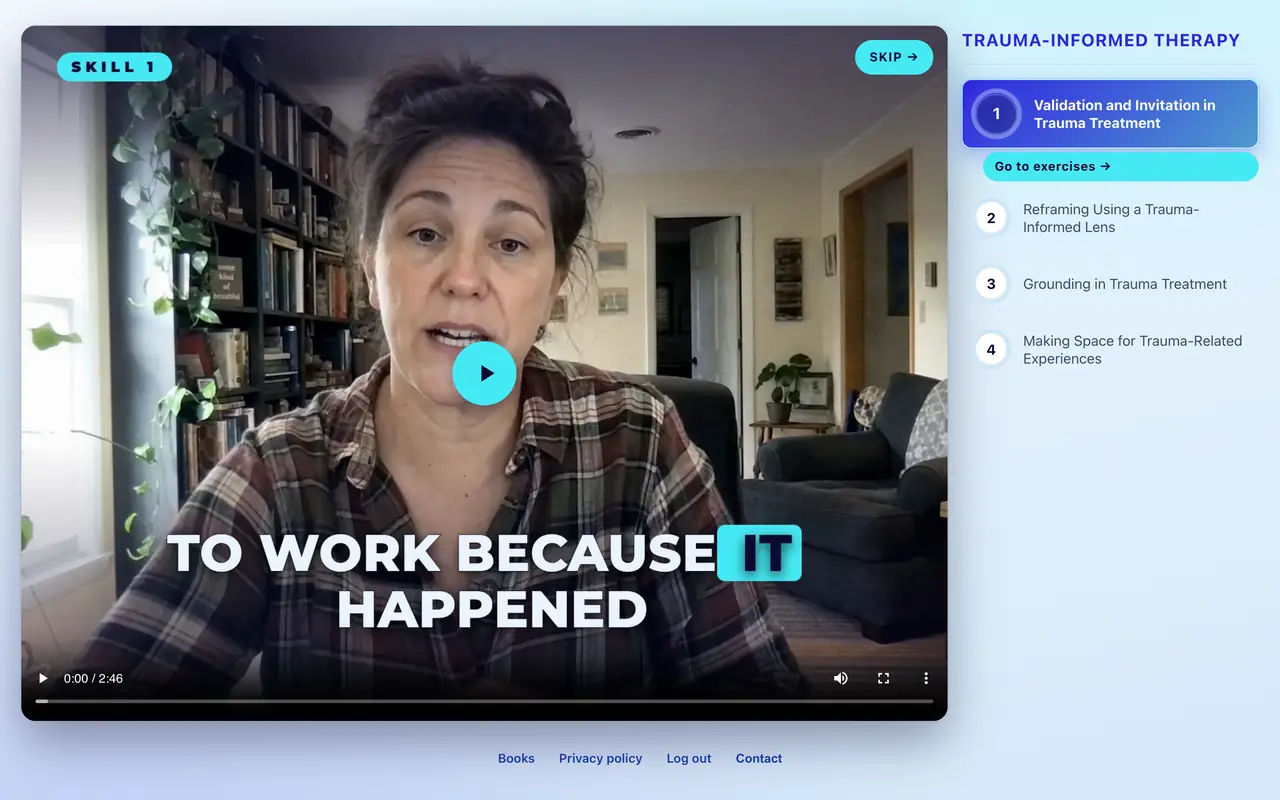
Trauma-informed therapy puts safety and choice first. PracticeTherapy.ai has a free Trauma-Informed Therapy course with four skills, and here we'll explain the research behind them.
Trauma-informed therapy is a way of working that keeps the effects of trauma in mind in every response. The Trauma-Informed Therapy course on PracticeTherapy.ai has four skills and 60 exercises, and it is free for everyone, with no invite code needed.
The four skills, in the order they appear in the course:
- Validation and Invitation in Trauma Treatment
- Reframing Using a Trauma-Informed Lens
- Grounding in Trauma Treatment
- Making Space for Trauma-Related Experiences
What does trauma-informed mean?
The US federal definition comes from the Substance Abuse and Mental Health Services Administration (SAMHSA), which writes for whole programs and service systems and says individual trauma "results from an event, series of events, or set of circumstances" that a person experiences "as physically or emotionally harmful or life threatening", with "lasting adverse effects on the individual's functioning and mental, physical, social, emotional, or spiritual well-being" (SAMHSA, 2014). A trauma-informed program "realizes the widespread impact of trauma and understands potential paths for recovery", "recognizes the signs and symptoms of trauma in clients, families, staff, and others involved with the system", "responds by fully integrating knowledge about trauma into policies, procedures, and practices" and "seeks to actively resist re-traumatization" (SAMHSA, 2014).
The approach is a set of principles, not a technique: it reflects "adherence to six key principles rather than a prescribed set of practices or procedures" (SAMHSA, 2014), namely safety; trustworthiness and transparency; peer support; collaboration and mutuality; empowerment, voice and choice; and cultural, historical and gender issues. It also differs from trauma treatment as such: "A trauma informed approach is distinct from trauma-specific services or trauma systems" (SAMHSA, 2014), although it includes them. The course applies the same principles one response at a time, in what a therapist says.
Why do trauma symptoms look the way they do?
Many trauma symptoms began as a means of surviving, and humans have "innate, hard-wired, automatically activated defense behaviors, termed the defense cascade": arousal, then fight or flight, then freezing, which is "a flight-or-fight response put on hold", and, when escape fails, immobility or collapse (Kozlowska and colleagues, 2015). The trouble comes afterward: "Unlike animals, which generally are able to restore their standard mode of functioning once the danger is past, humans often are not" (Kozlowska and colleagues, 2015).
The window of tolerance is a useful map. Daniel Siegel (1999) described a range of arousal, between the extremes of the sympathetic and parasympathetic nervous systems, "within which emotions are manageable and experiences can be integrated", as a recent paper summarizes it (Vatanparast and colleagues, 2024). People with a narrow window "find fluctuations unmanageable and dysregulating", and "traumatized individuals, especially those with repeated or prolonged childhood trauma" tend to have one (Vatanparast and colleagues, 2024). The paper links hyperarousal, above the window, to "impulsivity, aggression, fear, anxiety, panic, hypervigilance, flashbacks, and nightmares", and hypoarousal, below it, to "exhaustion, numbness, depression, shame, catatonia, poor digestion, and dissociation".
Why does safety come first?
In Judith Herman's words, "The recovery process may be conceptualized in three stages: establishing safety, retelling the story of the traumatic event, and reconnecting with others" (Herman, 1998). Treatment "must be appropriate to the survivor's stage of recovery" (Herman, 1998).
The guidelines of the International Society for Traumatic Stress Studies (ISTSS) for complex posttraumatic stress disorder (PTSD) recommend the same three phases. "Phase 1 focuses on ensuring the individual's safety, reducing symptoms, and increasing important emotional, social and psychological competencies", and in that phase the relationship works "through the expression of support, validation, encouragement" (Cloitre and colleagues, 2012).
Safety first is widely endorsed. What the course takes from the phase model is narrower: high emotional arousal "can interfere with information processing, new learning, and problem solving", as the American Psychological Association's (APA) deliberate practice book on dialectical behavior therapy (DBT) puts it, so a person who is flooded may not be able to take in anything new (Boritz and colleagues, 2023).
What is the evidence?
For PTSD specifically, trauma-focused psychotherapies have the strongest evidence, and the APA's clinical practice guideline strongly recommends cognitive behavioral therapy, cognitive processing therapy, cognitive therapy and prolonged exposure (Guideline Development Panel, 2019). In the course we train no trauma-focused therapy, only what to say around any of them, because it is practice for therapists and not a treatment or a crisis tool. It adds to supervision rather than replacing it, and the American Psychological Association's deliberate practice book on cognitive behavioral therapy says of its own methods: they "are not intended to replace or stand in for work performance or work with actual clients or training cases and case-based supervision" (Boswell and Constantino, 2022).
Trauma-informed care as a service model, which has been widely adopted as a principle-based approach to services, is a different matter, and the relational skills the course trains have their own evidence: empathy, for example, "is a moderately strong predictor of therapy outcome" across 82 samples and more than 6,000 clients (Elliott and colleagues, 2018), and the research on validation, acceptance and the alliance is set out in What are the common factors in therapy?.
What does this work ask of the therapist?
Hearing trauma stories is hard on the listener: when a client is angry, suicidal or in the middle of describing a trauma, the therapist may feel uncomfortable, and this discomfort can lead therapists to "detach, change the subject, or even argue with clients" (Goldman and colleagues, 2021).
There is no way to stop having these reactions. The goal of Rousmaniere's training manual is "to gradually (and self-compassionately) increase our inner skills and psychological capacity so we can perform better for our clients", through "deliberately practicing internal approach behaviors with stimuli that mimic therapy conditions" (Rousmaniere, 2019), and rehearsing these four skills out loud, with realistic clients, is similar to that kind of practice.
Some client lines describe heavy events, such as assault, abuse, loss and accidents, and practice with trauma material can also bring up a trainee's own memories: in the American Psychological Association's deliberate practice book on cognitive behavioral therapy, the exercises "may stir up complex or uncomfortable personal reactions within trainees, including, for example, memories of past traumas", "Trainees must have the final say about what to disclose or not disclose to their trainer" and training should "not blur into personal therapy" (Boswell and Constantino, 2022). Rousmaniere lists signs that training "may be dangerous or too hard for you to benefit", such as nausea, dizziness, numbness, feeling detached from the body and severe shame, and the advice is to stop and reduce the intensity if a round brings them on (Rousmaniere, 2019).
How was the course built?
The four exercises were created by Alexandre Vaz for Sentio University's marriage and family therapy program. For each skill, 18 of Sentio's 30 client statements became the course's 15 exercises (5 beginner, 5 intermediate and 5 advanced) and 3 worked examples, and the other 12 were kept back as a hidden test set for the coach, while the unskilled therapist responses were produced specifically for this site, and for sensitive lines they are realistic slips, such as the labels "Steered away" and "Minimized", and never responses that are harmful or dismiss risk.
Each exercise is a short video of a client: the therapist answers out loud, and an AI voice coach tells the therapist right away whether the answer met the skill's criteria. In order to get an answer "right", the therapist needs to hit all the criteria that apply to that answer. How a round works, step by step, is in Can you practice therapy skills on your own?.
Why do we validate in trauma-informed therapy?
Validation and Invitation in Trauma Treatment, the first skill, has two criteria: "Reflect/validate the client's distress" and "Ask a gentle, open-ended question about the client's presenting problem, giving them control over how much to disclose."
Validation comes first. That is because a person who feels believed calms enough to think and talk, while a person who feels doubted or rushed becomes more aroused and more guarded: when people feel invalidated, "it is common for emotional arousal to increase" (Boritz and colleagues, 2023). In the deliberate practice book on dialectical behavior therapy, validation "(a) decreases emotional arousal, (b) helps clients learn to trust their responses, (c) makes problem solving possible, and (d) strengthens the therapeutic alliance", and people with a history of pervasive invalidation "may be particularly sensitive to invalidation" (Boritz and colleagues, 2023). The nearest evidence goes in the same direction. In a laboratory experiment, participants exposed to invalidating responses "experienced significantly higher levels of negative affect, heart rate, and skin conductance over time" than did participants exposed to validating responses (Shenk and Fruzzetti, 2011). Among survivors of interpersonal violence, negative reactions to their disclosure (in particular, controlling them, distracting them and treating them differently) were associated with worse mental health (Dworkin and colleagues, 2019).
In Herman's words, "The essential features of psychological trauma are disempowerment and disconnection from others", so recovery "is based upon empowerment of the survivor and restoration of relationships" (Herman, 1998), and the invitation gives control back. SAMHSA's principle of empowerment, voice and choice asks staff to be "facilitators of recovery rather than controllers of recovery" (SAMHSA, 2014). Disclosure cuts both ways. Women in therapy with a history of childhood sexual abuse reported benefits such as "a sense of relief from sharing bottled-up emotions, and feeling more accepted and understood by one's therapist", and negative consequences such as "feeling emotionally overwhelmed, and feeling uncomfortably vulnerable and exposed" (Farber and colleagues, 2014). The authors advise clinicians to be "cautious in encouraging disclosure" with more severely affected clients (Farber and colleagues, 2014).
The heart of validation and invitation is to believe and accompany, rather than to extract: say that the client's distress makes sense, then open a door that the client may or may not walk through, and the validation and invitation skill builds choice into the question: the model answers in this course include phrases such as "When you feel ready" and "only if it feels right for you". Note that the question is about "the client's presenting problem", not the details of the trauma. Sentio's own example asks: "Is there anything you feel comfortable sharing about when this started or how it feels for you now?"
Thirteen of the course's 18 unskilled examples for this skill are labeled "Reassured", "Problem-solved", "Minimized" or "Demanded disclosure", like "So how fast were you going when the accident happened?" to a client trapped in memories of a car accident. The others are labeled "Gave advice", "Asked a question", "Steered away" ("It's okay, let's talk about something a little easier for now") and "Made it about me" ("I know exactly how you feel, I've been through some hard things too").
To a client who says "Every time I step inside that building, a wave of anxiety just hits me and my heart starts racing", the model answer begins "It makes sense that being at work feels unsafe after what happened there," and asks, when the client feels ready, whether they would like to explore how it has affected their daily life. The coach is told that "The open-ended question must explicitly use tentative and gentle language."
Why do we reframe trauma symptoms as survival responses?
Reframing Using a Trauma-Informed Lens, the second skill, has one criterion: "Reframe trauma symptoms as valid and learned (brain-body) survival mechanisms." Sentio's exercise sets the scene: "Assume the client has previously disclosed about early traumatic experiences, and that there is already a safe, trusting rapport."
Many trauma symptoms began life as the mind and body's best attempt at survival (to fight, to flee, to freeze, to go numb or detach). SAMHSA sums this up in one sentence: "People's experience and behavior are understood in the context of coping strategies designed to survive adversity and overwhelming circumstances" (SAMHSA, 2014). Freezing shows why this matters. Tonic immobility is common during a sexual assault. When 298 women attended an emergency clinic within a month of a sexual assault, "70% reported significant tonic immobility" (Möller and colleagues, 2017), which is "a state of involuntary, temporary motor inhibition". Active resistance is often assumed to be the normal reaction to assault (Möller and colleagues, 2017).
With the reframe, the client's "something is wrong with me" becomes "this makes sense given what happened". This can help to reduce shame and fear of the symptom. The reframe is offered not as a stand-alone fix but as part of the therapeutic relationship. Beliefs such as self-blame are important for recovery. In prolonged exposure therapy for PTSD, for example, "session-to-session reductions in PTSD-related cognitions drove successive reductions in PTSD symptoms" (Zalta and colleagues, 2014). These cognitions were measured with a scale which includes self-blame.
At the heart of the reframing skill is the idea that the symptom must be honored before anything is attempted. First validate the experience. Then explain, in simple warm language, how the symptom protected the client. The course's model answers for the reframing skill start with validation ("It makes sense", "That's a valid experience") then move on to what the symptom is protecting the client from ("Your body is still trying to protect you from threats, even when they're not there now."). In the deliberate practice book on accelerated experiential dynamic psychotherapy, "we do not go to war with defenses" (Prenn and colleagues, 2025), and in the emotion-focused therapy book the client "is often more able to absorb what the therapist is offering when emotional safety has been provided" (Goldman and colleagues, 2021).
Fourteen of the 18 unskilled examples of reframing are labeled "Gave advice", "Challenged it", "Problem-solved" or "Pathologized". These include "You have to stop those thoughts, they're irrational and they hold you back" and "That sounds like dissociation, it's a symptom we'll need to treat". Both of these are telling the client their reaction is a defect, the very thing the reframe is supposed to change. In the course, a client says they feel detached from their body, and the model answer is "That disconnection makes a lot of sense. Your body learned to detach from overwhelming sensations and feelings to protect you."
Why do we ground a client in trauma treatment?
Grounding in Trauma Treatment, the third skill, asks for "clear, simple instructions" that ground the client "in their body or surroundings (e.g. focusing on their breath, naming objects in the room)", in the words of the course's criterion, and its model answers use the body and the senses.
The course's clients say things like "My thoughts are just swirling around and I can't get out of this loop no matter how hard I try" and "I feel so disconnected from everything, like I'm floating above everything happening around me." Hammond and Brown (2026) propose defining therapeutic grounding as a constellation of techniques that "engage one or more of the five basic human senses to return an individual to a state of physiological equilibrium", which in the course means bringing the client back inside the window of tolerance. In DBT, a therapist coaching a client in crisis attends "to the client's affect rather than the content of the crisis" (Boritz and colleagues, 2023).
Grounding is widely recommended practice: it is a way to stabilize within treatment. Some of its ingredients have general support. The DBT practice book explains that "Our bodies naturally relax when we breathe out", so breathing out for longer than you breathe in helps the body relax (Boritz and colleagues, 2023). In a meta-analysis of randomized trials, breathwork was associated with lower stress, with "a significant small-to-medium mean effect size" and with similar effects on anxiety and depressive symptoms (Fincham and colleagues, 2023).
The coach is told that "Grounding asks for an instruction the client could physically follow right now to bring attention into the body or the room", and to "imagine the client trying to DO what the response says". Sentio's own example is simple and done together: "Can we slow things down by taking three deep breaths together?"
Ground a client who is outside of what they can bear (flooded, panicking or dissociating). "If the client is clearly overwhelmed, then you do want to downregulate their anxiety" states the deliberate practice book on accelerated experiential dynamic psychotherapy (Prenn and colleagues, 2025). However, when a client is in distress but present, stay with the feeling because "As long as we are within the window of tolerance, it is okay to push, encourage, and proceed" (Russell, 2021); in the course we held back a line from a client which amounted to passive suicidal thoughts (grounding is no substitute for risk assessment), because a checklist that looked only for grounding techniques would have marked a correct risk response as wrong.
Of the 18 unskilled examples for the skill of grounding, 9 are labeled as "Problem-solved", "Explored the past" or "Asked why", 3 are labeled "Reassured" or "Just reassured" and 2 are labeled "Only reflected", like "It sounds like you're really caught up in your thoughts right now", a bare reflection that passes in many skills but describes the state and gives the client nothing to do here. The other 4 are labeled "Asked to analyze", "Dismissed it", "Minimized" and "Labeled it".
Why do we make space for trauma-related feelings?
Making Space for Trauma-Related Experiences, the fourth skill, has three criteria: "Acknowledge the client's specific emotion or experience", "Offer a gentle invitation for the client to stay with their experience" and "Explicitly give the client permission to avoid managing or controlling their experience." The third was added to Sentio's two criteria, drawn from the permission already inside Sentio's own example.
Avoidance keeps trauma frightening and unprocessed: in the cognitive model of PTSD, the disorder persists because changes in the trauma memory and its meaning "are prevented by a series of problematic behavioural and cognitive strategies", such as avoidance and thought suppression (Ehlers and Clark, 2000). Lewis and colleagues (2020) found "robust evidence" for cognitive behavioral therapy "with a trauma focus", which has the client approach the memory and its meaning rather than avoid them, and Making Space applies the same principle in a gentle, in-session way that moves at a pace the client can bear.
Permission not to try to control the feeling is useful, because trying to control it is often what keeps it there, and the evidence supports the claim that acceptance helps people to be with feelings and to recover from them, not that it makes the feelings go away: in a randomized experiment, 60 people with anxiety and mood disorders listened to either "a rationale for suppressing emotions" or "a rationale for accepting emotions" and then watched an upsetting film. Although both groups reported similar levels of subjective distress during the film, "the acceptance group displayed less negative affect during the post-film recovery period", and "the suppression group showed increased heart rate and the acceptance group decreased heart rate" (Campbell-Sills and colleagues, 2006).
For the client, making space means feeling something hard with someone steady by their side and finding out that it can be felt without disaster, and sharing the client's felt experience "underscores that the client is not alone" (Dames and colleagues, 2024).
The heart is to be a calm witness: someone steady by the client's side who is not "scrambling to fix it, reduce it, or paper over it with affirmations and encouragement" (Dames and colleagues, 2024). Sentio's own example asks: "Could we just bring a gentle awareness to that weight pressing down, noticing it together without needing to make it go away?"
Beginners rush to fix the feeling or soothe it away: 9 of the course's 18 unskilled examples for this skill are labeled "Rushed to fix" or "Reassured", like "You're not broken, and we're going to work on building you back up," and the others are labeled "Soothed it away" ("It's okay, you don't have to cry, just take your time"), "Told to let go", "Analyzed it", "Steered away", "Problem-solved" or "Gave advice". The pull usually comes from the therapist: countertransference in this work "most commonly takes the form of emotional attachment to relieving the client's suffering" (Dames and colleagues, 2024).
In the course's example, the model answer begins "I hear the intensity of that fear bubbling up." and asks how it would feel to stay with the feeling and let it be there "without needing to run from it". The coach is told that "The invitation must explicitly use tentative and gentle language."
Trauma-Informed Therapy
Four skills for the moments when a client's trauma shows up in the room, practiced out loud with an AI voice coach.
About the author

Sources
- Substance Abuse and Mental Health Services Administration. (2014). SAMHSA's concept of trauma and guidance for a trauma-informed approach (HHS Publication No. (SMA) 14-4884). https://library.samhsa.gov/product/samhsas-concept-trauma-and-guidance-trauma-informed-approach/sma14-4884
- Kozlowska, K., Walker, P., McLean, L., & Carrive, P. (2015). Fear and the defense cascade: Clinical implications and management. Harvard Review of Psychiatry, 23(4), 263-287. https://doi.org/10.1097/HRP.0000000000000065
- Siegel, D. J. (1999). The developing mind: Toward a neurobiology of interpersonal experience. Guilford Press.
- Vatanparast, A., Shakiba, S., Momeni, F., & Kamrani, A. (2024). The relationship between childhood maltreatment and self-harm: The mediating roles of alexithymia, dissociation, internalizing and posttraumatic symptoms. European Journal of Psychotraumatology, 15(1), Article 2378642. https://doi.org/10.1080/20008066.2024.2378642
- Herman, J. L. (1998). Recovery from psychological trauma. Psychiatry and Clinical Neurosciences, 52(S1). https://doi.org/10.1046/j.1440-1819.1998.0520s5s145.x
- Cloitre, M., Courtois, C. A., Ford, J. D., Green, B. L., Alexander, P., Briere, J., Herman, J. L., Lanius, R., Stolbach, B. C., Spinazzola, J., van der Kolk, B. A., & van der Hart, O. (2012). The ISTSS expert consensus treatment guidelines for complex PTSD in adults. International Society for Traumatic Stress Studies.
- Boritz, T., McMain, S., Vaz, A., & Rousmaniere, T. (2023). Deliberate practice in dialectical behavior therapy. American Psychological Association. https://doi.org/10.1037/0000322-000
- Guideline Development Panel for the Treatment of PTSD in Adults, American Psychological Association. (2019). Summary of the clinical practice guideline for the treatment of posttraumatic stress disorder (PTSD) in adults. American Psychologist, 74(5), 596-607. https://doi.org/10.1037/amp0000473
- Lewis, C., Roberts, N. P., Andrew, M., Starling, E., & Bisson, J. I. (2020). Psychological therapies for post-traumatic stress disorder in adults: Systematic review and meta-analysis. European Journal of Psychotraumatology, 11(1), Article 1729633. https://doi.org/10.1080/20008198.2020.1729633
- Elliott, R., Bohart, A. C., Watson, J. C., & Murphy, D. (2018). Therapist empathy and client outcome: An updated meta-analysis. Psychotherapy, 55(4), 399-410. https://doi.org/10.1037/pst0000175
- Goldman, R. N., Vaz, A., & Rousmaniere, T. (2021). Deliberate practice in emotion-focused therapy. American Psychological Association. https://doi.org/10.1037/0000227-000
- Rousmaniere, T. (2019). Mastering the inner skills of psychotherapy: A deliberate practice manual. Gold Lantern Books.
- Boswell, J. F., & Constantino, M. J. (2022). Deliberate practice in cognitive behavioral therapy. American Psychological Association. https://doi.org/10.1037/0000256-000 (cited for the deliberate practice introduction shared by the books of the American Psychological Association's Essentials of Deliberate Practice series)
- Shenk, C. E., & Fruzzetti, A. E. (2011). The impact of validating and invalidating responses on emotional reactivity. Journal of Social and Clinical Psychology, 30(2), 163-183. https://doi.org/10.1521/jscp.2011.30.2.163
- Dworkin, E. R., Brill, C. D., & Ullman, S. E. (2019). Social reactions to disclosure of interpersonal violence and psychopathology: A systematic review and meta-analysis. Clinical Psychology Review, 72, Article 101750. https://doi.org/10.1016/j.cpr.2019.101750
- Farber, B. A., Feldman, S., & Wright, A. J. (2014). Client disclosure and therapist response in psychotherapy with women with a history of childhood sexual abuse. Psychotherapy Research, 24(3), 316-326. https://doi.org/10.1080/10503307.2013.817695
- Möller, A., Söndergaard, H. P., & Helström, L. (2017). Tonic immobility during sexual assault: A common reaction predicting post-traumatic stress disorder and severe depression. Acta Obstetricia et Gynecologica Scandinavica, 96(8), 932-938. https://doi.org/10.1111/aogs.13174
- Zalta, A. K., Gillihan, S. J., Fisher, A. J., Mintz, J., McLean, C. P., Yehuda, R., & Foa, E. B. (2014). Change in negative cognitions associated with PTSD predicts symptom reduction in prolonged exposure. Journal of Consulting and Clinical Psychology, 82(1), 171-175. https://doi.org/10.1037/a0034735
- Prenn, N. C. N., Levenson, H., Vaz, A., & Rousmaniere, T. (2025). Deliberate practice in accelerated experiential dynamic psychotherapy. American Psychological Association. https://doi.org/10.1037/0000439-000
- Hammond, J., & Brown, W. J. (2026). Building an operational definition of grounding. Trauma, Violence, & Abuse, 27(4), 1340-1353. https://doi.org/10.1177/15248380251343189
- Fincham, G. W., Strauss, C., Montero-Marin, J., & Cavanagh, K. (2023). Effect of breathwork on stress and mental health: A meta-analysis of randomised-controlled trials. Scientific Reports, 13, Article 432. https://doi.org/10.1038/s41598-022-27247-y
- Russell, E. (2021). Agency, will, and desire as core affective experience. In D. Fosha (Ed.), Undoing aloneness and the transformation of suffering into flourishing: AEDP 2.0 (pp. 241-265). American Psychological Association. https://doi.org/10.1037/0000232-010
- Ehlers, A., & Clark, D. M. (2000). A cognitive model of posttraumatic stress disorder. Behaviour Research and Therapy, 38(4), 319-345. https://doi.org/10.1016/S0005-7967(99)00123-0
- Campbell-Sills, L., Barlow, D. H., Brown, T. A., & Hofmann, S. G. (2006). Effects of suppression and acceptance on emotional responses of individuals with anxiety and mood disorders. Behaviour Research and Therapy, 44(9), 1251-1263. https://doi.org/10.1016/j.brat.2005.10.001
- Dames, S., Penn, A., Williams, M., Zamaria, J. A., Rousmaniere, T., & Vaz, A. (2024). Deliberate practice in psychedelic-assisted therapy. American Psychological Association. https://doi.org/10.1037/0000399-000
- PracticeTherapy.ai course data: the four Sentio exercises (created by Alexandre Vaz for the Sentio Marriage and Family Therapy program), the course criteria, model answers and unskilled examples, and the notes on how the course was built (internal).