
What are the common factors in therapy, and how do you practice them?
Common factors are the relationship skills all talk therapies share. PracticeTherapy.ai has a free Common Factors Therapy course with nine skills, and here we'll explain the research behind them.
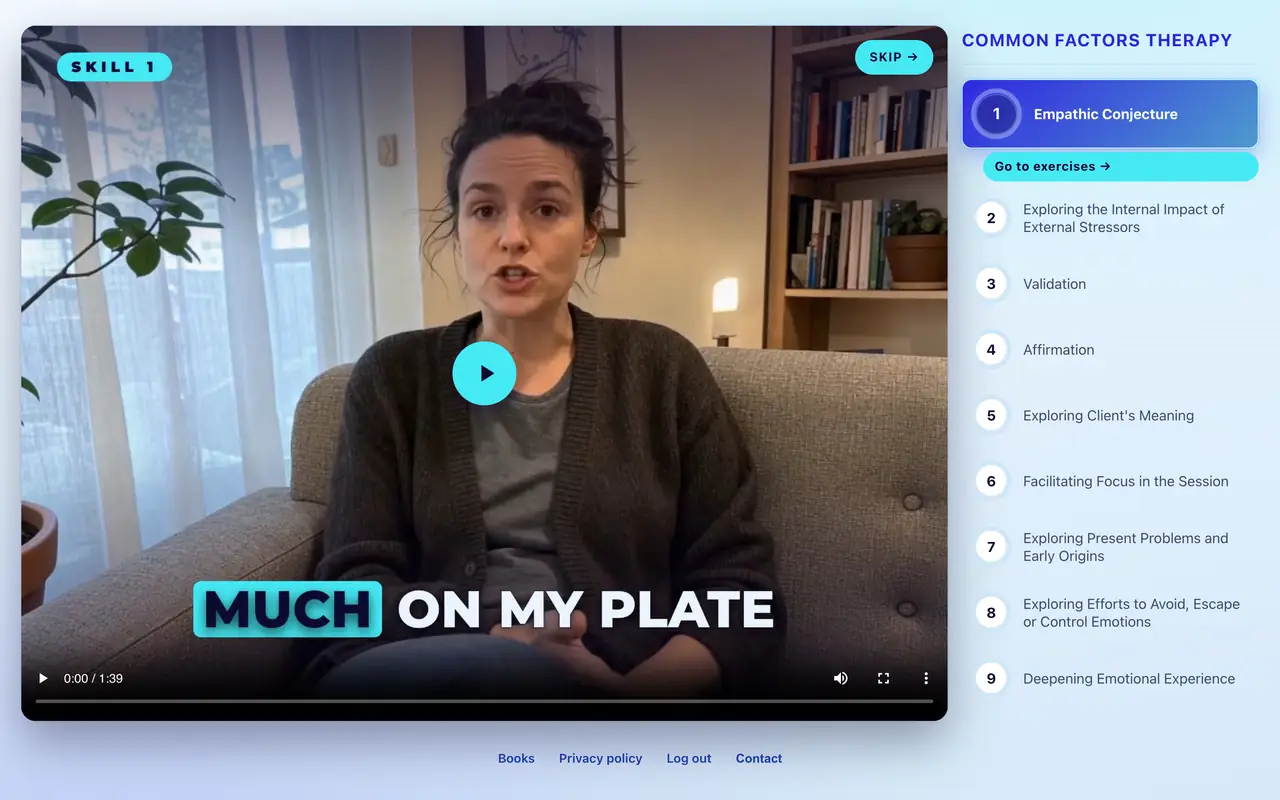
Common Factors Therapy trains the relationship skills that help clients in every kind of talk therapy. That means understanding a client accurately and accepting them, affirming what's good in them and agreeing on where the work is going, and helping them feel what they've been holding at arm's length. Models share these ingredients, hence the name common factors, while a model-specific technique belongs to just one model. The course on PracticeTherapy.ai is free (no invite code) and has nine of these skills in 135 exercises, each a short video of a client saying one thing to you. You answer out loud, and right away an AI voice coach gives you feedback about how well you did, which of the skill's criteria weren't met, and hints along the way. This kind of practice is the equivalent of learning to play scales for the cello before going to play a concert.
The exercises are donated by Sentio University from its graduate program for marriage and family therapists. Sentio credits most of them to Alexandre Vaz, several adapted from the American Psychological Association's (APA) deliberate practice books, and the examples of unskilled answers shown with each exercise were written for this site. The reasoning behind each skill in this article leans on the course's reference text, Effective Psychotherapists by William R. Miller and Theresa B. Moyers (2021), a book about the clinical skills that improve client outcomes.
The nine skills, in course order:
- Empathic Conjecture
- Exploring the Internal Impact of External Stressors
- Validation
- Affirmation
- Exploring Client's Meaning
- Facilitating Focus in the Session
- Exploring Present Problems and Early Origins
- Exploring Efforts to Avoid, Escape or Control Emotions
- Deepening Emotional Experience
What are the common factors?
They are the therapist qualities that help clients whatever the model, such as accurate empathy, warmth and acceptance. Truax and Carkhuff began measuring and training these "active ingredients" of therapy in the 1960s, and they came to be called common or nonspecific factors (Miller and Moyers, 2021).
Miller and Moyers prefer the name therapeutic skills, because these qualities are neither common nor vague. They are not common: in a 1960 study, fewer than 5 percent of 2,474 responses from 126 psychiatrists showed even mild warmth (Strupp, 1960). And they are not vague, because they can be described, measured and taught. In the authors' words, they are "not personality traits, but interpersonal skills that can be improved over time" (Miller and Moyers, 2021).
Their book names eight skills of more effective therapists: accurate empathy, acceptance, positive regard, genuineness, focus, hope and expectation, evoking, and offering information and advice. Its aim, in its own image, is "developing better chefs" rather than better recipes (Miller and Moyers, 2021). The course puts several of these into practice: empathy in Empathic Conjecture, acceptance in Validation, positive regard in Affirmation and focus in Facilitating Focus in the Session. The APA's deliberate practice series describes the same family as "common factor variables and facilitative interpersonal skills" (Boswell and Constantino, 2022).
How do the common factors help clients change?
The best-known account is Bruce Wampold's contextual model, which "posits that there are three pathways through which psychotherapy produces benefits" (Wampold, 2015). The first is the real relationship with a caring person. Hope is the second, which Wampold describes as "the creation of expectations through explanation of disorder and the treatment involved", and it grows when the client finds the explanation of their distress, and a treatment that fits it, convincing. Then comes action, "the enactment of health promoting actions" that the treatment gets the client to take. All three rest on a first bond: "Before these pathways can be activated, an initial therapeutic relationship must be established" (Wampold, 2015).
Rosenzweig was already writing about "implicit common factors in diverse methods of psychotherapy" in 1936, and he argued that a therapy's theory need not be completely true for the therapy to succeed (Rosenzweig, 1936).
Many therapeutic attitudes have been described over the years, and Miller and Moyers (2021) single out two that sit underneath every skill. Compassion, perhaps the most fundamental, is a commitment to relieve suffering, and in a helping relationship "the prime directive is the client's well-being". Partnership comes from the fact that people make their own choices about what they will do and how they will live, so efforts to push or coerce change can have the opposite effect. In their words, "It is not like wrestling; it's more like dancing together." Rogers called the inner side of these skills the therapist's "attitudes", Truax and Carkhuff measured and trained the outer side, and Miller and Moyers add, "Practice influences attitude, and vice versa." What clients say in session predicts their outcomes, and therapists steer it with what they ask about, reflect and affirm, or as Miller and Moyers put it, "It matters what you ask."
What is the evidence for the common factors?
Seven decades of research show "important and often large differences among therapists in client outcomes", even when they deliver the same highly structured treatment, and the differences follow relational skill more than credentials (Miller and Moyers, 2021). In a managed care study of 6,146 clients and 581 therapists, outcomes varied by therapist, not by the therapists' age, gender, experience or degree, and the type of treatment made no difference (Wampold and Brown, 2005). At one university counseling center, the clients of the three most effective of 91 therapists improved at about eight times the center's average rate, while the clients of the three least effective got worse on average (Okiishi and colleagues, 2003). One randomized trial, in Miller and Moyers' phrase, "stretched the limits of what it means to be a therapist". Its 23 graduate student helpers included 11 from a clinical psychology program and 12 from fields like chemistry, biology and history with no clinical training, and whatever their field, the helpers with stronger interpersonal skills had clients who improved more on every measure (Anderson, Crowley and colleagues, 2016). Across the 20 studies in a 2019 review, the therapist accounted for about 5 percent of the differences in outcome on average (8.2 percent in randomized trials, 5 percent in routine practice), anywhere from 0.2 to 29 percent depending on the study, and the reviewers concluded that "therapist effects are a robust phenomenon although considerable heterogeneity exists across studies" (Johns and colleagues, 2019).
Each core relationship skill has been linked to better outcomes in meta-analyses (statistical summaries of many studies). For the working alliance, the collaborative bond between client and therapist, that's 295 studies from 1978 to 2017 and more than 30,000 patients, with a stronger alliance going with better outcomes at r = .278 in face-to-face therapy and only 2 percent of the effect sizes negative, and the link "remains consistent across assessor perspectives, alliance and outcome measures, treatment approaches, patient characteristics, and countries" (Flückiger and colleagues, 2018). Empathy came in at r = .28 across 82 samples and 6,138 clients (Elliott and colleagues, 2018). An APA task force that reviewed this research concluded that "the psychotherapy relationship makes substantial and consistent contributions to outcome independent of the type of treatment" (Norcross and Lambert, 2018).
The choice of model matters far less, and after decades of comparisons the American Psychological Association said in a 2012 resolution that the findings suggest "most valid and structured psychotherapies are roughly equivalent in effectiveness" (Rousmaniere, 2025). Rosenzweig had a joke name for this back in 1936, the "dodo bird verdict", after the scene in Alice in Wonderland where everyone wins a prize (Rosenzweig, 1936). Each relationship factor accounts for about ten times more of the differences in outcomes than the choice of model or adherence to it, and specific techniques for less than 1 percent (Norcross, 2011; Wampold and Imel, 2015). A meta-analysis of 36 studies found that "therapist adherence and competence play little role in determining symptom change" (Webb and colleagues, 2010).
None of this makes technique useless. Miller and Moyers ask whether a good meal comes from the chef or the ingredients, and answer that the trouble is the word "or": "Specific ingredients and common factors are not mutually exclusive but work together to make psychotherapy effective" (Wampold and Ulvenes, 2019). A clear treatment rationale, for example, is a technique of a specific model that also builds the common factor of hope (Rousmaniere, 2025).
Truax and Carkhuff got closer to cause in a 1965 experiment, where therapists deliberately switched between high and low levels of these skills within sessions and their clients' self-exploration "tracked the therapists' responses as predicted" (Miller and Moyers, 2021).
Why practice them one skill at a time?
Miller and Moyers (2021) write that it is "probably easiest to focus on developing one of these therapeutic skills at a time", the way Benjamin Franklin worked on each of his 13 virtues for a week at a time instead of on all of them together, and they put accurate empathy first in their book so skills like acceptance and affirmation could build on it. Therapists' expertise and their clients' outcomes "generally do not improve with years of experience", a well-replicated finding (Miller and Moyers, 2021). Deliberate practice with feedback has improved skills in early studies (Rousmaniere, 2025). The APA's deliberate practice books go after skills that trainees "could write a good paper about" and still struggle to perform with a real client, and the series calls that gap the "sweet spot" for deliberate practice (Boswell and Constantino, 2022). When Rousmaniere first told Jason Whipple about his plans for a book on deliberate practice, Whipple's reply was "Beware the fad." His advice was to focus practice on the basic interpersonal skills first, or it could turn into one more model that ends up explaining about 1 percent of outcome like all the others, and Rousmaniere calls the advice smart (Rousmaniere, 2025). Miller and Moyers also recommend teaching these skills early in training.
Each skill in the course has 15 exercises, 5 beginner, 5 intermediate and 5 advanced, plus worked examples. A client says one line on video and you answer out loud, the way you would in a session. In skill practice there are specific criteria, two or three per skill here, and the question is really whether you met the clinical criteria, so that's what the voice coach focuses on, and an answer passes only if it meets every one that applies. The criteria are on the screen too, along with a clinician-authored example answer to be inspired by and a common mistake with its label, such as "Asked a question". There's a step-by-step walk through one round in Can you practice therapy skills on your own?.
It is the site's most practiced course, with about four in five of all attempts on the site. The misses thinned out as people worked through a skill. Pooled over the nine skills, 53.6 percent of tries at a skill's first beginner exercise ended without a pass, against 31.9 percent at its fifth.
Why do we offer empathic conjectures?
The first skill, Empathic Conjecture, is a careful guess at the feeling beneath a client's words and at what it means to them, offered as a statement. Every answer has to start with "It sounds like you're feeling...", and after that you tentatively name a feeling under what the client said and guess at its meaning for them.
Of all the therapist skills, accurate empathy is the one most consistently linked to better outcomes (Elliott and colleagues, 2018; Miller and Moyers, 2021), and a conjecture is about as active as empathy gets. In Miller and Moyers' words, reflective listening is "not passive, but active listening": you guess at "what has not (yet) been said". It's "not an echo chamber" where you merely repeat what you heard; you say what might be "the next sentence in the paragraph". At first you may stay close to the person's words, and "as you gain understanding, you make gradual guesses", which helps a client keep exploring their own experience and finding words for what they'd only hinted at, and lets you check and correct your understanding along the way. The emotion-focused therapy practice book describes the same move as conjecturing, speculating or "hunching" about what might be beyond what the client is experiencing, as in "My hunch is that you might feel..." (Goldman and colleagues, 2021). Laws and colleagues (2018) coded motivational interviewing sessions with 132 emergency department patients, and complex reflections (which go past the client's words, as a conjecture does) and open questions "appeared to be more strongly associated" with a client moving from arguing against change to talking about change than other techniques.
"A fundamental attitude in empathic understanding is curiosity," Miller and Moyers (2021) write, "an openness to and interest in another's experience." Nobody starts out with an accurate understanding of someone else's life, which is why they recommend "a beginner's mind", and what you think you understand goes out as a guess the client is free to correct. The guess has to come from the client's frame of reference, and the therapist "treads carefully", taking it back if the client disagrees (Goldman and colleagues, 2021). The opener is a statement because, as Miller and Moyers put it, reflections said as statements "tend to flow like a normal conversation, whereas the same words posed as questions may foster defensiveness".
The usual slip is fixing things before you understand them, and 14 of the course's 16 examples of unskilled answers for this skill are labeled "Problem-solved", "Gave advice", "Asked a question" or "Reassured". A client says tasks are "stacking up faster than I can blink", and one of them answers, "Have you tried writing out a to-do list and tackling one task at a time?" Thomas Gordon listed 12 kinds of responses people offer instead of listening and called them roadblocks, because the speaker has to go around them to keep exploring their own train of thought, and Miller and Moyers (2021) add that they aren't always wrong, just "different from (and often easier than) accurate empathy". A near miss names a feeling and stops there, skipping the third criterion, "Guess at the underlying meaning for the client." Guessing at causes or history misses too, because a conjecture is "about inner experience", not causes, and that guess turns into an interpretation (Goldman and colleagues, 2021).
In the course, the model answer to that client keeps the guess tentative with the fixed opener and gives both a feeling and a meaning, which is what the coach checks: "It sounds like you're feeling really stressed with all those tasks piling up and no way to keep up." In a randomized trial with 36 students, deliberate practice improved empathic expression more than lecture-style training did (Larsson and colleagues, 2023).
Why explore the internal impact of external stressors?
"My car broke down again, and this is the third time this month," a client says in one of this skill's exercises. Clients often arrive talking about what's happening to them like that, and the second skill, Exploring the Internal Impact of External Stressors, turns from the event to the person: the criteria are to "start with a brief reflection or validating comment" and then "invite the client to elaborate on the internal impact of the external stressors being described".
Therapy works on the client's experience of events, not on the events themselves, and accurate empathy means "seeking to understand the client's own perspective and experience" (Miller and Moyers, 2021). The Experiencing Scale rates on seven points how deeply a client engages their own experience, from detached accounts of events at the low end to the client's own feelings and point of view in the middle, and deeper experiencing in session predicts better outcomes (Pascual-Leone and Yeryomenko, 2017). When you ask a question, Miller and Moyers write, "you direct the client's (and your) attention", so a question about the client's inner experience points you both there.
In 31 sessions by expert therapists, Wiser and Goldfried (1998) found "reflections and acknowledgments, affiliative and noncontrolling interventions" going with clients who stayed in deep experiencing, and lengthier or more controlling ones going with drops to shallow experiencing. The skill's heart is to attend to the person, not the problem, or, as the APA's deliberate practice book on dialectical behavior therapy (DBT) puts it for a client in crisis, to attend "to the client's affect rather than the content of the crisis" (Boritz and colleagues, 2023).
Beginners try to solve the external problem. Of the course's 16 unskilled examples for this skill, 14 give advice or problem-solve, like "Sounds rough. Could you ask your boss to redistribute some of those projects?" to a client with three projects due at once and a boss who keeps adding more. Another asks for more facts, which keeps the talk on the event. The model answer stays with the person: "It sounds like this was a really stressful week for you. How has this situation at work been affecting you personally?"
Why do we validate a client's experience?
With Validation, the third skill, you tell a client that their thoughts, feelings or actions make sense given their situation. First you reflect the experience they stated or implied, and then you say what makes sense about it.
The DBT practice book gives four reasons to validate: it helps clients learn to trust their own responses, makes problem solving possible, strengthens the alliance and, first on its list, lowers emotional arousal (Boritz and colleagues, 2023). Studies back the arousal reason: after a stressful task, people who received invalidating responses had higher negative affect, heart rate and skin conductance than people who were validated (Shenk and Fruzzetti, 2011), and clients who felt more validated than usual in a session ended it with less negative affect (Benitez and colleagues, 2019). Acceptance has a long clinical record, going back at least to Whitehorn and Betz's 1954 study, in which the seven psychiatrists whose clients with schizophrenia improved most were rated more accepting, "respectful, sympathetic, and active", than the seven whose clients improved least (Whitehorn and Betz, 1954). In a trial with women who met criteria for opioid dependence and borderline personality disorder, a therapy built on warmth, acceptance and validation alone did about as well as full DBT, with no dropouts in a year against 36 percent in DBT (Linehan and colleagues, 2002).
For the client, validation carries the message "No wonder you feel this way, given what has happened to you in your life" (Goldman and colleagues, 2021). It can also counter the demoralizing ideas a client holds about themselves, with a kinder explanation in their place (Vaz and Sousa, 2021). And clients who share something vulnerable and get no judgment, disapproval or immediate direction back "often are surprised and relieved" (Miller and Moyers, 2021).
You find what's understandable in a reaction and say it, which isn't the same as agreeing, and the DBT book's rule is to "only validate what makes sense about the client's response and avoid validating the invalid" (Boritz and colleagues, 2023). When one of its clients says of a mother who wouldn't stop nagging, "So I got really in her face and screamed at her," the therapist validates the irritation and the wish to end the situation ("I can totally understand feeling irritated or overwhelmed") without endorsing the screaming. Approval is a different move again, since "even approval can be judgmental, in that it implies an appraisal (in this case, positive) of a client's experience" (Miller and Moyers, 2021).
Beginners fix, reassure or argue instead, and the course's 16 unskilled examples for this skill carry eight different labels: "Gave advice", "Problem-solved", "Minimized", "Asked a question", "Got defensive", "Reassured", "Disagreed" and "Judged". One of them, "If you'd just commit to practicing the skills daily, you'd have time to use them," gives advice and implies the client is to blame. The DBT book lists subtler mistakes as well, from an overly professional manner or a therapist who "fragilizes the client", and praise instead of validation, to being misattuned to "the essence of the client's response" (Boritz and colleagues, 2023). In the course, when a client says coping skills are useless because their anxiety goes "from zero to 100", the model answer is "It makes sense that when you're at 100, it feels impossible to stop and use any skills."
Why do we affirm clients?
Affirmation, the fourth skill, is a genuine, specific acknowledgment of a client's effort, achievement or positive quality. The course asks you to express that acknowledgment, and to match your tone of voice and nonverbal behavior to the affirming words.
Affirmation is positive regard, Rogers' prizing of the client, made specific and observable (Miller and Moyers, 2021), and positive regard is linked to better outcomes across 64 studies (Farber and colleagues, 2018). In research on motivational interviewing, "Affirm was the only therapist behavior that both increased change talk and also reduced sustain talk" (Apodaca and colleagues, 2016): after an affirmation, clients talked more in favor of change and argued less for staying the same. Outside motivational interviewing, one study that tracked what clients said right after each therapist response found that clients in cognitive behavioral therapy kept talking about whatever the therapist affirmed (Karpiak and Benjamin, 2004). Miller and Moyers know of no clinical science showing that withholding affirmation helps, and between too withholding and too affirming, they write, "we favor the latter".
For the client, an affirmation names something they cannot see in themselves right now. Linking a present action to a lasting strength can leave clients "encouraged, heartened, optimistic, and willing to take risks or make difficult choices" (Miller and Moyers, 2021).
The heart is genuine, specific appreciation. Name something real the client did or is, ideally tied to a lasting strength, as in Miller and Moyers' (2021) example "You deeply love your children and want to do all you can to protect them." There's "something inherently evaluative" about starting with "I", they write, even in "I'm proud of you", while "You're doing really well" keeps the focus on the client. In the words of the APA's deliberate practice book on accelerated experiential dynamic psychotherapy (AEDP), affirming "is not about being kind or saying nice things" (Prenn and colleagues, 2025). In AEDP, matching your voice and posture to the words is "very important", because a soft voice or leaning in can "speak directly to the client's emotional center" in a way the words alone cannot (Prenn and colleagues, 2025).
Ten of the course's 16 unskilled examples are labeled "Asked a question", which is the most common beginner miss, skipping the affirmation to ask for more information. In the course, the worked example's unskilled answer skips the client's first success and asks: "And does that self-blaming voice still show up most days for you?" Shallow or generic affirmations backfire too, "coming across as empty disingenuous praise" (Miller and Moyers, 2021), and affirming the wrong thing reinforces it: in one study, affirming maladaptive content predicted poorer outcomes a year later (Karpiak and Benjamin, 2004).
The course's Affirmation exercise comes from the AEDP practice book, expanded by Alexandre Vaz. "I noticed that old self-blaming voice creeping in, but this time, I also felt my anger," the client in its worked example says, and it's the first time she has recognized being angry without turning it against herself, so the model answer calls that "such an important step" after opening with "Wow, this is a big deal!" The tone criterion is on the screen as a reminder to practice in your own voice, but the coach only gets a transcript of your words, so it generally doesn't give feedback on tone.
Why explore what a client means?
Exploring Client's Meaning, the fifth skill, slows down before responding to what a client seems to mean. The two criteria are to "begin with a short reflection or validating comment" and then "invite the client to elaborate on an element that is vague in their statement".
Miller and Moyers (2021) list three ways communication falters: people don't always say exactly what they mean, listeners mishear because of things like background noise or accents, and even when you catch every word, you still "look it up in your mental dictionary". The danger, they write, "is in assuming that your interpretation of the words you think you heard is what the person actually meant." A client who is talking about suicide may be vague on purpose, staying guarded for fear of what disclosure could set in motion (hospitalization, for one) or using vague words to test the relationship (Scholz and colleagues, 2026). The exercise comes from the APA's deliberate practice book on assessing self-directed violence, where a client who says "I'm feeling at the end of my rope" might simply be sad or might be thinking of hurting themself, so the therapist asks, "What do you mean by 'feeling at the end of your rope'?" (Scholz and colleagues, 2026).
A curious, culturally humble approach "allows for the client to guide the interpretative process, rather than the therapist" (Scholz and colleagues, 2026), and it can bring conflicted feelings and ambivalence into the open. The nearest research is from motivational interviewing sessions with 92 college students, who were more likely to talk about change right after open questions and reflections and less likely right after closed questions (Apodaca and colleagues, 2016).
Before concluding anything, you reflect what you heard and then ask about the vague word or phrase with one open question, the kind the self-directed violence book calls "specific to one issue at a time and open-ended in nature, usually beginning with 'what' or 'how'" (Scholz and colleagues, 2026). Good reflections mean fewer questions, which matters because "excessive questions can sometimes elicit client defensiveness" (Scholz and colleagues, 2026).
In the course, a client says: "Some days I wonder if everyone would be better off if I'm gone." The model answer reflects the sense of being a burden, then asks: "What do you mean when you say being 'gone'?" The unskilled example, "I'm sure the people in your life would miss you more than you realize right now," reassures and closes the topic instead. Ten of the course's 16 unskilled examples for this skill are labeled "Problem-solved" or "Changed the subject" and three more "Reassured", and every one of them answers the meaning the therapist assumed.
Why facilitate focus in a session?
The sixth skill, Facilitating Focus in the Session, gives the hour a direction while the client keeps a say in where it goes. After a short reflection or validating comment you either ask "a brief focusing question that offers the client a choice between topics" or ask what feels most important to explore right now.
More effective therapists have "clear goals and a coherent plan for reaching them with their clients" (Miller and Moyers, 2021). Across 54 studies with 7,278 patients, agreement between patient and therapist on the goals of therapy correlated r = .24 with outcome, and collaboration correlated r = .29 across 53 studies (Tryon and colleagues, 2018). In ongoing counseling, Miller and Moyers note, "a surprising amount of time can be used in informal 'chat'", and in one study they describe, more of that off-topic chat went with lower client motivation for change and lower retention. Offering a choice of topic is goal consensus and collaboration in everyday, in-session form, and Tryon and colleagues (2018) advise therapists to "seek input from patients to form and effect treatment goals and plans".
Focusing is "a shared decision-making process to identify clear goals" (Miller and Moyers, 2021), and a goal is not shared until the client agrees with it. It's "not uncommon" for clients to arrive "in an emotionally dysregulated state, reporting many complex problems", the DBT book says, and setting the agenda together can make the session feel "less chaotic and overwhelming" for both of you and bring their arousal down (Boritz and colleagues, 2023).
Miller and Moyers (2021) ask you to think of a spotlight on an actor, where too tight a beam "could illuminate just one part of the person, perhaps a foot" and too broad a beam floods the whole stage, so they want "a guiding balance" of direction and empathic connection, with the client choosing where to start. Their agenda-setting example is a "bubble sheet" that a diabetes educator might introduce with "Here are a dozen different things that people can do to get better control of their diabetes," leaving one bubble blank in case something else matters more, and it ends, "Which of these do you think might be a good place to start?"
Nine of the course's 16 unskilled examples for this skill carry the label "Picked the topic", like "Okay, let's dig into these panic attacks and what's triggering them at school." Drift is the opposite miss, and for it Miller and Moyers (2021) describe "a soft warning light" and "a sense of discomfort, if for session after session you have no identified goals for your work together". In the course, the model answer to that student says the panic attacks sound really tough, and asks: "Would it feel helpful to dive into what's happening at school, or is there something else on your mind?"
Why link present problems to early origins?
Exploring Present Problems and Early Origins, the seventh skill, connects what hurts now with where it may have started. The course asks for three steps: suggest a possible link between the client's problem and past experiences, suggest that understanding the link could help, and invite the client to explore early experiences related to the problem.
Many therapy traditions share the idea behind this skill, that ways of feeling and relating (learned early in life) which once protected a person can keep them stuck now. An emphasis on past experience is one of the features that research found to distinguish psychodynamic-interpersonal therapy from cognitive behavioral therapy (Blagys and Hilsenroth, 2000). Schema therapy proposes that "difficulties in adult life may be linked with unmet core emotional needs in childhood", such as secure attachment, and the beliefs that form around those needs get triggered later "by conditions that resemble early life experiences" (Behary and colleagues, 2023).
Insight, defined as understanding the links between past and present experiences and recurring relationship patterns, correlated r = 0.31 with treatment outcome across 23 effect sizes, and its authors conclude that "Insight may be a relevant mechanism of change across different treatment modalities" (Jennissen and colleagues, 2018).
In the schema therapy book, a client who has "never been able to maintain relationships" hears, "It sounds like this difficulty in maintaining relationships is a theme in your life, representing what we call a schema," and a link offered that way can turn a baffling reaction into a pattern the client can understand (Behary and colleagues, 2023). Schema language early in therapy "provides clients with a framework to help make sense of their problems, thereby facilitating a positive therapeutic alliance" (Behary and colleagues, 2023), and Wampold's "creation of expectations" (Wampold, 2015) is echoed in the course's second step: understanding the link could help, which gives the client a reason to look back that serves the present.
The key word in the first criterion is "possible": you "suggest a possible link", which the two of you can explore and the client is free to take up or decline, and stating it as a fact misses the skill. The psychodynamic book calls defenses "self-protective acts", so it validates such patterns before questioning them, with "an attitude of intense curiosity" (Levenson and colleagues, 2023).
Twelve of the course's 16 unskilled examples give advice or problem-solve, like this one to a client who finds it hard to trust anyone: "Have you tried starting small, like trusting people with little things first?" The opposite risk is digging through painful history with no link to what the client wants: Miller and Moyers (2021) describe a counselor they coached who treated it as therapeutic for clients to describe their most negative emotions and past adversities in great detail; shifting toward the clients' values, goals and strengths dramatically improved sessions and retention. In the course, the model answer to that client says that not trusting people makes sense after being hurt, suggests that exploring where it came from might help, and asks: "Can you think of any early experiences or relationships where you started feeling like this?"
Why explore efforts to avoid, escape or control emotions?
Exploring Efforts to Avoid, Escape or Control Emotions, the eighth skill, gets curious about what a client does with painful feelings. The course asks you to start with a brief reflection or validating comment, then ask about the client's possible efforts to avoid, escape or control their emotions.
Avoiding feelings brings relief now and keeps problems going. Consistently avoiding emotional cues reinforces the belief that emotions are intolerable, and it costs the client the information their feelings carry (Boritz and colleagues, 2023). Experiential avoidance, "attempts to reduce distressing thoughts, feelings, or other negative subjective experiences even when doing so is ineffective and causes problems" (Scherr and colleagues, 2015), correlates at about r = .5 with symptoms of anxiety, depression and posttraumatic stress disorder (PTSD) across 441 studies (Akbari and colleagues, 2022). A review of 12 mediation studies of acceptance and commitment therapy found results "generally consistent with the psychological flexibility model" (Stockton and colleagues, 2019). Exploring avoidance in session also has long agreement behind it, across psychodynamic, experiential and behavioral therapies.
Named out loud, the habit shows what it protects the client from and what it costs them, since avoidance that feels safe in the moment can "stunt one's awareness, flexibility, intimacy, and authenticity" (Levenson and colleagues, 2023). Defensive patterns are learned so early that they feel like personality, and "until they are pointed out, we do not have a means of changing them" (Levenson and colleagues, 2023).
In AEDP "we do not go to war with defenses", and therapists try hard not to shame clients for strategies that "were probably brilliantly adaptive for them growing up but now are getting in their way" (Prenn and colleagues, 2025). Its therapists help the client "be curious about the defense", and they say what they notice the client doing in place of feeling, with no judgment in it, and wonder about it together (Prenn and colleagues, 2025).
Many beginner answers recommend still more avoidance. Giving advice is the miss in 10 of the course's 16 unskilled examples, often a coping trick for pushing the feeling away, like "Breakups take time; have you tried staying busy to keep your mind off it?" to a client still emotional months after a breakup. Therapists avoid too: discomfort when a client is angry, suicidal or describing trauma can make a therapist "detach, change the subject, or even argue with clients" (Goldman and colleagues, 2021). In the course, the model answer to that client is "Breakups can really mess with our emotions. What do you tend to do when those feelings come up?"
Why deepen emotional experience?
Deepening Emotional Experience, the ninth skill, helps a client move from talking about a feeling to feeling it. The course asks you to give a brief reflection or validating comment, then invite the client to explore their emotional experience or physical sensations in the here and now.
It's "a relatively consistent finding", Miller and Moyers (2021) write, that clients who engage their feelings more deeply in session, instead of talking about them from a distance, have better outcomes, across many kinds of therapy. Pascual-Leone and Yeryomenko's (2017) meta-analysis of 10 studies and 406 clients found deeper experiencing predicting more symptom improvement by the end of treatment (r = -.19, the minus sign meaning more depth went with fewer symptoms) and concluded that "Client experiencing is a small to medium predictor of treatment outcomes and a probable common factor". Sentio University calls it "increasingly cited as a common factor in psychotherapy outcome research" (Sentio University, n.d.).
The psychodynamic book wants the therapist to be an "emotional detective/midwife/catalyst", evoking and deepening emotion so that, with someone attuned beside them, a client's nascent feelings can be recognized, named and understood in the session and become "gateways for change" instead of something they talk around (Levenson and colleagues, 2023). Clients are usually unaware that their physical sensations go with their emotional reactions, the AEDP book notes, and paying attention to the body helps them use "the information emotions give them" (Prenn and colleagues, 2025).
AEDP's invitation is simply "Let's stay with this", and "The essence of this skill is to help the client experience where they are" (Prenn and colleagues, 2025). What keeps a client there is the core relational skills: empathy, acceptance, positive regard and genuineness help clients sustain deep experiencing (Miller and Moyers, 2021).
A client says, "My partner and I are always fighting. I just don't know what to do anymore; it's like we can't communicate..." Say you answer, "What do you think is actually causing all the communication to break down?", which the course labels "Intellectualized" because it pulls the client up into their head, while Natasha Prenn, lead author of the AEDP practice book, describes a gentler way of pulling a client away from the feeling: moving so quickly to settle her clients' anxiety that they stayed regulated but distant from their core feelings, and quotes the line "People can be too regulated to grow" (Russell, 2021).
Deepening is not always the right move: the emotion-focused therapy practice book notes that deepening some emotions is not appropriate with clients who are highly dysregulated, psychotic or suicidal (Goldman and colleagues, 2021), and when a client is clearly overwhelmed, the first job is to help them settle (Prenn and colleagues, 2025), and for the client who is always fighting with their partner, the model answer is "It sounds like you're in a really tough spot with all that fighting... As you're talking about it, what are you feeling right now, in your body?"
Where can you go from here?
Sentio's free Learn Psychotherapy Podcast has a practice-along first season titled "The Common Factors of Psychotherapy", based on the same APA deliberate practice series; its skill list differs from the course's but shares its theme (Sentio University, n.d.). The method behind every exercise is in What is deliberate practice for therapists?.
Common Factors Therapy
Nine relationship skills that every talk therapy shares, practiced out loud with an AI voice coach.
About the author

Sources
- Miller, W. R., & Moyers, T. B. (2021). Effective psychotherapists: Clinical skills that improve client outcomes. The Guilford Press. ISBN 9781462545353.
- Wampold, B. E. (2015). How important are the common factors in psychotherapy? An update. World Psychiatry, 14(3), 270-277. https://doi.org/10.1002/wps.20238
- Rosenzweig, S. (1936). Some implicit common factors in diverse methods of psychotherapy. American Journal of Orthopsychiatry, 6(3), 412-415.
- Rousmaniere, T. (2025). Deliberate practice for psychotherapists: A guide to improving clinical effectiveness (2nd ed.). Routledge. https://doi.org/10.4324/9781003400622
- Strupp, H. H. (1960). Psychotherapists in action: Explorations of the therapist's contribution to the treatment process. Grune & Stratton.
- Boswell, J. F., & Constantino, M. J. (2022). Deliberate practice in cognitive behavioral therapy. American Psychological Association. https://doi.org/10.1037/0000256-000 (cited for the deliberate practice introduction shared by the books of the American Psychological Association's Essentials of Deliberate Practice series)
- Wampold, B. E., & Brown, G. S. (2005). Estimating variability in outcomes attributable to therapists: A naturalistic study of outcomes in managed care. Journal of Consulting and Clinical Psychology, 73(5), 914-923.
- Okiishi, J., Lambert, M. J., Nielsen, S. L., & Ogles, B. M. (2003). Waiting for supershrink: An empirical analysis of therapist effects. Clinical Psychology and Psychotherapy, 10, 361-373.
- Anderson, T., Crowley, M. E. J., Himawan, L., Holmberg, J. K., & Uhlin, B. D. (2016). Therapist facilitative interpersonal skills and training status: A randomized clinical trial on alliance and outcome. Psychotherapy Research, 26(5), 511-529. https://doi.org/10.1080/10503307.2015.1049671
- Johns, R. G., Barkham, M., Kellett, S., & Saxon, D. (2019). A systematic review of therapist effects: A critical narrative update and refinement to review. Clinical Psychology Review, 67, 78-93. https://doi.org/10.1016/j.cpr.2018.08.004
- Flückiger, C., Del Re, A. C., Wampold, B. E., & Horvath, A. O. (2018). The alliance in adult psychotherapy: A meta-analytic synthesis. Psychotherapy, 55(4), 316-340. https://doi.org/10.1037/pst0000172
- Elliott, R., Bohart, A. C., Watson, J. C., & Murphy, D. (2018). Therapist empathy and client outcome: An updated meta-analysis. Psychotherapy, 55(4), 399-410. https://doi.org/10.1037/pst0000175
- Farber, B. A., Suzuki, J. Y., & Lynch, D. A. (2018). Positive regard and psychotherapy outcome: A meta-analytic review. Psychotherapy, 55(4), 411-423. https://doi.org/10.1037/pst0000171
- Tryon, G. S., Birch, S. E., & Verkuilen, J. (2018). Meta-analyses of the relation of goal consensus and collaboration to psychotherapy outcome. Psychotherapy, 55(4), 372-383. https://doi.org/10.1037/pst0000170
- Norcross, J. C., & Lambert, M. J. (2018). Psychotherapy relationships that work III. Psychotherapy, 55(4), 303-315. https://doi.org/10.1037/pst0000193
- Norcross, J. C. (2011). Psychotherapy relationships that work: Evidence-based responsiveness (2nd ed.). Oxford University Press.
- Wampold, B. E., & Imel, Z. E. (2015). The great psychotherapy debate: The evidence for what makes psychotherapy work (2nd ed.). Routledge. https://doi.org/10.4324/9780203582015
- Webb, C. A., DeRubeis, R. J., & Barber, J. P. (2010). Therapist adherence/competence and treatment outcome: A meta-analytic review. Journal of Consulting and Clinical Psychology, 78(2), 200-211. https://doi.org/10.1037/a0018912
- Wampold, B. E., & Ulvenes, P. G. (2019). Integration of common factors and specific ingredients. In J. C. Norcross & M. R. Goldfried (Eds.), Handbook of psychotherapy integration (3rd ed., pp. 69-87). Oxford University Press.
- Goldman, R. N., Vaz, A., & Rousmaniere, T. (2021). Deliberate practice in emotion-focused therapy. American Psychological Association. https://doi.org/10.1037/0000227-000
- Laws, M. B., Magill, M., Mastroleo, N. R., Gamarel, K. E., Howe, C. J., Walthers, J., Monti, P. M., Souza, T., Wilson, I. B., Rose, G. S., & Kahler, C. W. (2018). A sequential analysis of motivational interviewing technical skills and client responses. Journal of Substance Abuse Treatment, 92, 27-34. https://doi.org/10.1016/j.jsat.2018.06.006
- Larsson, J., Werthén, D., Carlsson, J., Salim, O., Davidsson, E., Vaz, A., ... Norberg, J. (2023). Does deliberate practice surpass didactic training in learning empathy skills? A randomized controlled study. Nordic Psychology. https://doi.org/10.1080/19012276.2023.2247572
- Pascual-Leone, A., & Yeryomenko, N. (2017). The client "experiencing" scale as a predictor of treatment outcomes: A meta-analysis on psychotherapy process. Psychotherapy Research, 27(6), 653-665. https://doi.org/10.1080/10503307.2016.1152409
- Wiser, S., & Goldfried, M. R. (1998). Therapist interventions and client emotional experiencing in expert psychodynamic-interpersonal and cognitive-behavioral therapies. Journal of Consulting and Clinical Psychology, 66(4), 634-640. https://doi.org/10.1037/0022-006X.66.4.634
- Boritz, T., McMain, S., Vaz, A., & Rousmaniere, T. (2023). Deliberate practice in dialectical behavior therapy. American Psychological Association. https://doi.org/10.1037/0000322-000
- Shenk, C. E., & Fruzzetti, A. E. (2011). The impact of validating and invalidating responses on emotional reactivity. Journal of Social and Clinical Psychology, 30(2), 163-183. https://doi.org/10.1521/jscp.2011.30.2.163
- Benitez, C., Southward, M. W., Altenburger, E. M., Howard, K. P., & Cheavens, J. S. (2019). The within-person effects of validation and invalidation on in-session changes in affect. Personality Disorders: Theory, Research, and Treatment, 10(5), 406-415. https://doi.org/10.1037/per0000331
- Whitehorn, J. C., & Betz, B. J. (1954). A study of psychotherapeutic relationships between physicians and schizophrenic patients. American Journal of Psychiatry, 111, 321-331.
- Linehan, M. M., Dimeff, L. A., Reynolds, S. K., Comtois, K. A., Welch, S. S., Heagerty, P., & Kivlahan, D. R. (2002). Dialectical behavior therapy versus comprehensive validation therapy plus 12-step for the treatment of opioid dependent women meeting criteria for borderline personality disorder. Drug and Alcohol Dependence, 67(1), 13-26.
- Vaz, A., & Sousa, D. (2021). Persuasiveness: An underappreciated characteristic of effective therapists. Psychology of Consciousness: Theory, Research, and Practice. https://doi.org/10.1037/cns0000309
- Apodaca, T. R., Jackson, K. M., Borsari, B., Magill, M., Longabaugh, R., Mastroleo, N. R., & Barnett, N. P. (2016). Which individual therapist behaviors elicit client change talk and sustain talk in motivational interviewing? Journal of Substance Abuse Treatment, 61, 60-65. https://doi.org/10.1016/j.jsat.2015.09.001
- Prenn, N. C. N., Levenson, H., Vaz, A., & Rousmaniere, T. (2025). Deliberate practice in accelerated experiential dynamic psychotherapy. American Psychological Association. https://doi.org/10.1037/0000439-000
- Karpiak, C. P., & Benjamin, L. S. (2004). Therapist affirmation and the process and outcome of psychotherapy: Two sequential analytic studies. Journal of Clinical Psychology, 60(6), 659-676. https://doi.org/10.1002/jclp.10248
- Scholz, R., Hall, S. R., Van Brunt, B., Vaz, A., & Rousmaniere, T. (2026). Deliberate practice in assessing self-directed violence. American Psychological Association. https://doi.org/10.1037/0000497-000
- Levenson, H., Gay, V., & Binder, J. L. (2023). Deliberate practice in psychodynamic psychotherapy. American Psychological Association. https://doi.org/10.1037/0000351-000
- Blagys, M. D., & Hilsenroth, M. J. (2000). Distinctive features of short-term psychodynamic-interpersonal psychotherapy: A review of the comparative psychotherapy process literature. Clinical Psychology: Science and Practice, 7(2), 167-188. https://doi.org/10.1093/clipsy.7.2.167
- Behary, W. T., Farrell, J. M., Vaz, A., & Rousmaniere, T. (2023). Deliberate practice in schema therapy. American Psychological Association. https://doi.org/10.1037/0000326-000
- Jennissen, S., Huber, J., Ehrenthal, J. C., Schauenburg, H., & Dinger, U. (2018). Association between insight and outcome of psychotherapy: Systematic review and meta-analysis. American Journal of Psychiatry, 175(10), 961-969. https://doi.org/10.1176/appi.ajp.2018.17080847
- Scherr, S. R., Herbert, J. D., & Forman, E. M. (2015). The role of therapist experiential avoidance in predicting therapist preference for exposure treatment for OCD. Journal of Contextual Behavioral Science, 4(1), 21-29. https://doi.org/10.1016/j.jcbs.2014.12.002
- Akbari, M., Seydavi, M., Hosseini, Z. S., Krafft, J., & Levin, M. E. (2022). Experiential avoidance in depression, anxiety, obsessive-compulsive related, and posttraumatic stress disorders: A comprehensive systematic review and meta-analysis. Journal of Contextual Behavioral Science, 24, 65-78. https://doi.org/10.1016/j.jcbs.2022.03.007
- Stockton, D., Kellett, S., Berrios, R., Sirois, F., Wilkinson, N., & Miles, G. (2019). Identifying the underlying mechanisms of change during acceptance and commitment therapy (ACT): A systematic review of contemporary mediation studies. Behavioural and Cognitive Psychotherapy, 47(3), 332-362. https://doi.org/10.1017/S1352465818000553
- Russell, E. (2021). Agency, will, and desire as core affective experience. In D. Fosha (Ed.), Undoing aloneness and the transformation of suffering into flourishing: AEDP 2.0 (pp. 241-265). American Psychological Association. https://doi.org/10.1037/0000232-010
- Sentio University. (n.d.). Promoting client experiencing in therapy. https://sentio.org/promoting-client-experiencing-deliberate-practice
- Sentio University. (n.d.). Learn Psychotherapy Podcast. https://sentio.org/learn-psychotherapy-podcast
- PracticeTherapy.ai course data and practice records: the Common Factors criteria, model answers and unskilled examples; all-time practice totals, test accounts excluded, as of 31 October 2026 (internal).