What is deliberate practice for therapists, and what does the research show?
Deliberate practice is focused, repeated rehearsal of one skill with feedback. The studies show it improves clinical skills, which is why PracticeTherapy.ai uses deliberate practice.
Deliberate practice is repeated, focused rehearsal of one specific skill with feedback, at a difficulty just above what you can already do. For a therapist, a round of deliberate practice can be as short as one line spoken by a client. The therapist responds out loud (just like in a therapy session) and then finds out if the answer did the few things the skill calls for. Then the therapist goes again.
While research on deliberate practice for therapists is still young, the early evidence is promising. Early studies find that it builds therapy skills better than lectures and traditional workshops, for trainees and licensed therapists alike (Mahon, 2022; Rousmaniere, 2025).
Where does deliberate practice come from?
From research on experts. In 1993, psychologist K. Anders Ericsson and two colleagues published a paper on expert performers. They concluded that top performance comes mainly from long, sustained practice of a particular kind, not from innate talent or years of doing the work (Ericsson and colleagues, 1993). Ericsson's classic definition of deliberate practice is "the individualized training activities specially designed by a coach or teacher to improve specific aspects of an individual's performance" (Ericsson and Lehmann, 1996), refined step by step through repetition.
The "10,000-hour rule" in Malcolm Gladwell's book Outliers took the idea to a wider audience. The rule spread two misunderstandings: that everyone needs the same number of hours, and that 10,000 hours of simply doing the work will make you an expert (Boswell and Constantino, 2022). The second one matters for therapists, because the profession has traditionally measured proficiency in hours of client contact (Boswell and Constantino, 2022). In the first large study to track therapists' results over time, 170 therapists working with 6,591 clients did not get better results with experience. In fact, their outcomes declined very slightly on average, although some therapists did improve, and early dropout fell as therapists gained experience (Goldberg and colleagues, 2016).
Today the American Psychological Association publishes more than a dozen deliberate practice books, each on one therapy approach or area of practice, in its Essentials of Deliberate Practice series, edited by Tony Rousmaniere and Alexandre Vaz of Sentio University (Rousmaniere, 2025). Sentio donated the material for two of this site's courses, a story told in Who wrote the exercises on PracticeTherapy.ai?
What makes practice deliberate?
Rousmaniere (2025), following Ericsson (2006), and the American Psychological Association's books (Boswell and Constantino, 2022) describe deliberate practice as a cycle of five activities that continues across a whole career:
- Observing your own work.
- Getting expert feedback.
- Setting small incremental learning goals just beyond your ability.
- Engaging in repetitive behavioral rehearsal of specific skills.
- Continuously assessing your performance.
In Rousmaniere's (2025) words, "We try to isolate the smallest components of skills, microskills, that are just beyond our ability." In traditional training, a coach may suggest that a therapist "listen more carefully". In deliberate practice, the coach isolates a microskill within listening carefully, such as "Watch the video of this client and count how many times you talk over the client."
Sentio University's rule is "challenging but not overwhelming": if an exercise is "either too easy or too hard, the student is unlikely to benefit from it" (Sentio University, n.d.).
And it should feel like work. As Rousmaniere (2025) puts it, "If it doesn't feel hard, then you're not advancing your skills." He also writes that "our practice is not mindless repetition, but a constant attempt to push ourselves." Practice locks in whatever you rehearse, mistakes included, and Alexandre Vaz ends his foreword to Rousmaniere's book with a three-word reminder: "practice makes permanent" (Rousmaniere, 2025).
Why isn't knowing about a skill enough?
Because knowing what a good response is and producing one in the moment are different abilities: in the series' words, "Declarative knowledge is what a person can understand, write, or speak about", while "Procedural knowledge is what a person can perform, especially under stress", which usually takes repetition to build (Boswell and Constantino, 2022).
The American Psychological Association's books open with Mary, a hypothetical second-year graduate school trainee with "near-perfect scores on her course exams" and a supervisor who uses "supervisory best practices". Yet in session with emotional clients, Mary freezes and "is unable to enact her supervisor's advice". The series editors' verdict: "In truth, we are all Mary" (Boswell and Constantino, 2022).
Deliberate practice aims at that gap: "The sweet spot for deliberate practice is the gap between declarative and procedural knowledge" (Boswell and Constantino, 2022). The books' exercises try to move each skill into procedural memory, the memory for how to do things, so that it is there even when you are tired, stressed or overwhelmed (Squire, 2004).
How is it different from the training most therapists get?
Traditional training relies on supervised clinical experience, reading and lectures (Rousmaniere, 2025; Katz and colleagues, 2023). Three activities often get lumped together, and two deliberate practice books separate them (Rousmaniere, 2025; Katz and colleagues, 2023):
- Routine work: seeing clients as usual.
- Conceptual learning: reading, attending lectures, participating in case discussions and watching videos of master therapists.
- Deliberate practice: rehearsing one specific skill repetitively and getting corrective feedback each time.
Conceptual learning is valuable, but it builds knowledge about a skill, while deliberate practice means performing the skill yourself (Rousmaniere, 2025). Even role-play isn't automatically deliberate practice. Traditional role-plays are typically "free-form dialogues" in which the therapist is presented with "constantly shifting clinical challenges", so the therapist never gets to repeat and hone one skill. For a role-play "to count as deliberate practice, the trainee must be presented repeatedly with the same type of challenging stimulus", with feedback each time (Rousmaniere, 2025).
Workshops and continuing education rarely close the gap by themselves. Reviews find little reliable evidence that continuing education makes therapists more effective, and Rousmaniere (2025) names three problems that current formats typically have: a passive learning format, being "taken sporadically, an evening lecture here and a weekend workshop there", and including "little or no observation of the participant's work".
What does a deliberate practice exercise look like?
It has three parts: client statements, sample responses, and skill criteria, the short checklist an answer is judged against (Sentio University, n.d.). In the books by the American Psychological Association, one trainee acts as the client, another as the therapist, and a trainer or a peer acts as an observer and gives feedback (Boswell and Constantino, 2022). The "client" reads a short statement, and the "therapist" comes up with a response in their own words using the skill instead of reading the sample response. Each statement gets a few attempts, and then brief feedback is given against the criteria.
Statements are divided into beginner, intermediate and advanced categories. The books call these grades "only estimates", because "some trainees may experience a stimulus of a client being angry to be easy to respond to, whereas another trainee may experience it as very difficult" (Boswell and Constantino, 2022). After each level, trainees rate how hard it was to meet the criteria on a scale from 0 to 10. A rating above 8, or any "too hard" reaction such as overwhelming shame or nausea, means the next round gets easier. A rating below 4, or no "good challenge" reaction such as manageable self-judgment or tension in the body, means it gets harder. Anything in between means the level is repeated (Manuel and colleagues, 2022). The purpose of a session "is not to get through all the client statements and therapist responses but to spend as much time as possible practicing at the correct difficulty level" (Boswell and Constantino, 2022).
Each skill on PracticeTherapy.ai has 15 exercises, five at each level, and a round takes about 37 seconds on average. The site uses the same format for one person practicing alone, with a video client in place of the partner who reads the lines and an AI voice coach in place of the observer, checking your words against the skill's criteria, which the screen shows along with a good example answer and an example of a common mistake. How a round works step by step, and what happens when you miss, is in Can you practice therapy skills on your own?. Why the client videos are made to feel real is in How realistic are PracticeTherapy.ai's video clients, and how are they made?
What does the research show about therapy skills?
Early studies indicate that deliberate practice develops therapy skills better than traditional training. The studies are still limited in number, mostly small and uneven in quality (Nurse and colleagues, 2024; Diamond and colleagues, 2025).
By September 2023, 18 peer-reviewed studies of deliberate practice in therapist training had been published. Together they found it more effective than traditional training for a wide range of clinical skills, for beginning trainees and licensed therapists, at the end of training and at follow-up (Rousmaniere, 2025). A 2022 scoping review of 14 studies called the field "still in its infancy" and found that deliberate practice compares "more favourably than usual didactic workshops for skill acquisition across variables such as techniques, communication skills and interpersonal and evidence-based relationship factors" (Mahon, 2022). A 2024 systematic review found eleven studies, nine of them reports from seven randomized controlled trials (the type of study that assigns learners to a training method by chance). In the reviewers' words, "All RCTs found the [deliberate practice] group performed better than the control group" (all seven trials, on skill performance), and they called the results "preliminary empirical support" for deliberate practice as a way to build specific therapy skills (Nurse and colleagues, 2024).
The skills studied vary widely: empathy (Larsson and colleagues, 2023), "transtheoretical emotional processing skills" such as "eliciting patient disclosure of difficult experiences" (Yamin and colleagues, 2023), and "managing ambivalence and resistance" (Westra and colleagues, 2021). Training in facilitative interpersonal skills, such as empathy and repairing strains in the relationship, showed "a marginally higher post-intervention level of overall therapeutic skills" (Perlman and colleagues, 2020); What are facilitative interpersonal skills, and how do you practice them? covers those trials.
One of those trials randomly assigned 88 community psychotherapists to a deliberate practice workshop or a traditional workshop on responding to ambivalence and resistance, both given by the same presenter. In the authors' words, "Both workshops produced equivalent trainee satisfaction and significant increases in self-reported skills" (Westra and colleagues, 2021). The deliberate practice group, however, "demonstrated better observer-rated skill on all performance measures postworkshop", and at the four-month follow-up its trainees "were rated as more empathic by community interviewees" (Westra and colleagues, 2021).
Is deliberate practice all it takes?
No. In studies of chess and music experts, "deliberate practice is necessary but not sufficient to account for individual differences in performance", because intelligence, personality and the age a person starts also matter (Hambrick and colleagues, 2014).
The series' cognitive behavioral therapy book says that book "is not intended to replace core coursework" but "to augment other common training components", and that deliberate practice methods "should play a complementary role in CBT training, in the service of augmenting core readings and work performance with real clients" and are not intended to "replace or stand in for work performance or work with actual clients or training cases and case-based supervision" (Boswell and Constantino, 2022).
How can you start?
Pick one skill, find a realistic client line that calls for it, and answer out loud, aiming "to practice improvising responses to the client statement in a manner that (a) is attuned to the client, (b) meets skill criteria as much as possible, and (c) feels authentic for the trainee", then get feedback against the criteria and go again, moving up a level when it starts to feel easy (Boswell and Constantino, 2022).
PracticeTherapy.ai is built to add practice between classes and supervision, and you can sign up free. Common Factors Therapy and Trauma-Informed Therapy are open to everyone with no invite code, and the first Common Factors skill, Empathic Conjecture, can serve as a good starting point; What are the common factors in therapy, and how do you practice them? covers all nine of its skills, and how the coach was tuned and tested is in Can an AI coach judge therapy responses accurately?
You can also practice without a screen: Sentio University publishes free deliberate practice materials, including client videos and a podcast with "Deliberate practice drills for six of the most important clinical skills", and suggests using them "in supervision, in peer practice groups, or as solo prep before a session" (Sentio University, n.d.). For more of the research, Sentio maintains a public reading list of "peer-reviewed research on Deliberate Practice as a method for developing clinical skill in psychotherapy, counseling, and related health professions", which held 47 citations from 2015 to 2026 as of 31 October 2026 (Sentio University, n.d.).
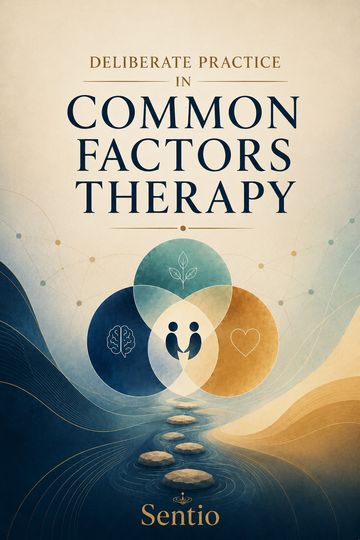
Common Factors Therapy
Nine relationship skills that every talk therapy shares, practiced out loud with an AI voice coach.
About the author

Sources
- Rousmaniere, T. (2025). Deliberate practice for psychotherapists: A guide to improving clinical effectiveness (2nd ed.). Routledge. https://doi.org/10.4324/9781003400622
- Boswell, J. F., & Constantino, M. J. (2022). Deliberate practice in cognitive behavioral therapy. American Psychological Association. https://doi.org/10.1037/0000256-000 (cited for the deliberate practice introduction shared by the 17 books of the American Psychological Association's Essentials of Deliberate Practice series, series editors Tony Rousmaniere and Alexandre Vaz)
- Katz, M., Christensen, M. J., Vaz, A., & Rousmaniere, T. (2023). Deliberate practice of TEAM-CBT. Springer. https://doi.org/10.1007/978-3-031-46019-7
- Manuel, J. K., Ernst, D., Vaz, A., & Rousmaniere, T. (2022). Deliberate practice in motivational interviewing. American Psychological Association. https://doi.org/10.1037/0000297-000
- Diamond, G., Wlodek, B., Arthey, S., & Parker, S. (2025). A systematic review of deliberate practice in psychotherapy: Definitions, operationalization, and preliminary outcomes. Psychotherapy, 62(2), 113-131. https://doi.org/10.1037/pst0000569
- Ericsson, K. A. (2006). The influence of experience and deliberate practice on the development of superior expert performance. In K. A. Ericsson, N. Charness, P. J. Feltovich, & R. R. Hoffman (Eds.), The Cambridge handbook of expertise and expert performance (pp. 683-703). Cambridge University Press. https://doi.org/10.1017/CBO9780511816796.038
- Ericsson, K. A., & Lehmann, A. C. (1996). Expert and exceptional performance: Evidence of maximal adaptation to task constraints. Annual Review of Psychology, 47, 273-305. https://doi.org/10.1146/annurev.psych.47.1.273
- Ericsson, K. A., Krampe, R. T., & Tesch-Römer, C. (1993). The role of deliberate practice in the acquisition of expert performance. Psychological Review, 100(3), 363-406. https://doi.org/10.1037/0033-295X.100.3.363
- Goldberg, S. B., Rousmaniere, T., Miller, S. D., Whipple, J., Nielsen, S. L., Hoyt, W. T., & Wampold, B. E. (2016). Do psychotherapists improve with time and experience? A longitudinal analysis of outcomes in a clinical setting. Journal of Counseling Psychology, 63(1), 1-11. https://doi.org/10.1037/cou0000131
- Hambrick, D. Z., Oswald, F. L., Altmann, E. M., Meinz, E. J., Gobet, F., & Campitelli, G. (2014). Deliberate practice: Is that all it takes to become an expert? Intelligence, 45, 34-45. https://doi.org/10.1016/j.intell.2013.04.001
- Larsson, J., Werthén, D., Carlsson, J., Salim, O., Davidsson, E., Vaz, A., Sousa, D., & Norberg, J. (2023). Does deliberate practice surpass didactic training in learning empathy skills? A randomized controlled study. Nordic Psychology, 77(1), 39-52. https://doi.org/10.1080/19012276.2023.2247572
- Mahon, D. (2022). A scoping review of deliberate practice in the acquisition of therapeutic skills and practices. Counselling and Psychotherapy Research, 23(4), 965-981. https://doi.org/10.1002/capr.12601
- Nurse, K., O'Shea, M., Ling, M., Castle, N., & Sheen, J. (2024). The influence of deliberate practice on skill performance in therapeutic practice: A systematic review of early studies. Psychotherapy Research, 35(3), 353-367. https://doi.org/10.1080/10503307.2024.2308159
- Perlman, M. R., Anderson, T., Foley, V. K., Mimnaugh, S., & Safran, J. D. (2020). The impact of alliance-focused and facilitative interpersonal relationship training on therapist skills: An RCT of brief training. Psychotherapy Research, 30(7), 871-884. https://doi.org/10.1080/10503307.2020.1722862
- Squire, L. R. (2004). Memory systems of the brain: A brief history and current perspective. Neurobiology of Learning and Memory, 82(3), 171-177. https://doi.org/10.1016/j.nlm.2004.06.005
- Westra, H. A., Norouzian, N., Poulin, L., Coyne, A., Constantino, M. J., Hara, K., Olson, D., & Antony, M. M. (2021). Testing a deliberate practice workshop for developing appropriate responsivity to resistance markers. Psychotherapy, 58(2), 175-185. https://doi.org/10.1037/pst0000311
- Yamin, J. B., Cannoy, C. N., Gibbins, K. M., Krohner, S., Rapport, L. J., Trentacosta, C. J., Zeman, L. L., & Lumley, M. A. (2023). Experiential training of mental health graduate students in emotional processing skills: A randomized, controlled trial. Psychotherapy, 60(4), 512-524. https://doi.org/10.1037/pst0000495
- Sentio University. (n.d.). Deliberate practice in marriage and family therapy training. https://sentio.org/deliberate-practice-in-mft-training
- Sentio University. (n.d.). Free therapist training resources from the Sentio University Innovation Lab. https://sentio.org/free-therapist-training
- Sentio University. (n.d.). Learn Psychotherapy Podcast. https://sentio.org/learn-psychotherapy-podcast
- Sentio University. (n.d.). Research on deliberate practice in therapist training and clinical supervision. https://sentio.org/research-on-deliberate-practice
- Sentio University. (n.d.). What is deliberate practice? https://sentio.org/what-is-deliberate-practice