
How realistic are PracticeTherapy.ai's video clients, and how are they made?
PracticeTherapy.ai's client videos have emotional expressiveness matching real humans you'd see in sessions. Each AI client starts as two written prompts, one for a photo and one for a performance. How age, clothing, setting, voice and emotion are set, with six clips.
Client videos needed non-verbal depth, emotional expressivity, and genuineness. They had to resemble real people so therapists can develop instincts for real clients. So each client on PracticeTherapy.ai is an AI-generated video of an ordinary person on a therapist's sofa or on a video call from home, showing one specific emotion in their face, voice and body, made ahead of time from two written prompts: one for a photo of the person and one for their performance, down to the breath before the first word. Every clip passes automatic checks and Justin's review before it gets posted on the site, and you can watch six of them below.
Why does a practice client need to feel real?
Because practice that feels like the real thing carries over best, deliberate practice uses what medical educators call simulation-based mastery learning: rehearsal in "contrived social situations that mimic problems, events, or conditions that arise in professional encounters" (McGaghie and colleagues, 2014). The same definition also names "lifelike virtual environments" (McGaghie and colleagues, 2014). People perform best in the same psychological state in which they learned, which is why pilots train with simulated engine failures and storms (Fisher and Craik, 1977; Smith, 1979).
There are a number of practical advantages to practicing with a simulated client (Baker, 2015). No actual client is involved. Mistakes can be made over and over again without causing any harm. Practice can pause in order to get feedback. Difficult or infrequent moments can be practiced on demand. Each trainee can move at their own pace. Military pilots who trained for a specific emergency in a simulator handled the same emergency better in real flight (Ericsson, 2004). There is research on practicing with video too. In a randomized study of 101 undergraduates, those who practiced responding to video stimuli showed stronger core relational skills, such as empathy and warmth, than a comparison group (Anderson and colleagues, 2019). I'm unfamiliar with another project using AI-generated video clients for these exercises. I don't see that as a problem, given that the AI-generated clients have more faithful emotional faithfulness to the relevant scenario than a practice partner reading a line of text.
The first tip in the deliberate practice books for whoever plays the client is to make the emotion real. Use an angry voice and fists for anger. Hunch and wince for shame. Use a soft, deflated voice for sadness. A line read flatly off the page doesn't stir the same reactions a hard session does (Boswell and Constantino, 2022). The prompts behind every client on PracticeTherapy.ai are written with the same aim: make the emotion real.
Who are the clients?
The client reference images were AI-generated on OpenAI's GPT Image 2 to vary across demographics, such as ethnicity, age, gender, outfits and location (Zoom or in-person). Clients are women, men and non-binary people, from teens to people in their seventies. A prompt can add a heritage, for example Mexican-American, Guatemalan-American or Cape Verdean. Each prompt sets four things: gender, age, ethnicity and setting, and the early prompts named an outfit too.
For clients who speak American English in the newer courses, the casting target is about 22% each African-American, Asian-American and Hispanic clients, with the remaining third from other backgrounds. Facilitative Interpersonal Skills is cast from the population of Portugal, about 80% from the Portuguese ethnic majority and 20% Afro-Portuguese, with the same photo serving the English and the European Portuguese version of a line. Newer prompts exclude flags, souvenirs and other national or ethnic symbols from the room.

Teenage girl, African-American, office 
Teenage boy, Hispanic, Zoom 
Woman, 20s, Hispanic, office 
Non-binary, 20s, Zoom 
Man, 20s, Asian-American, office 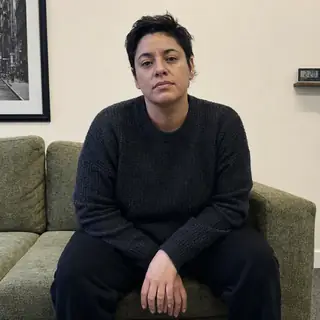
Non-binary, 30s, Hispanic, office 
Man, 30s, Afro-Portuguese, Zoom 
Man, 40s, office 
Man, 50s, African-American, Zoom 
Woman, 60s, Asian-American, Zoom 
Woman, 60s, Portuguese ethnic majority, Zoom 
Woman, 70s, Afro-Portuguese, office
So far, more than 1,100 photos have been made this way, and 554 have been approved for casting. Each new photo is first checked by an AI vision model to see if it's a realistic photo of a therapy client in a realistic therapy office or on a Zoom call from home. Then it's up to Justin to approve, reject or ask for a change. There's a little bit of work making sure random demographics line up with content (e.g., a 16 year old client isn't believable speaking about their "kids"). Rejected photos are retired for good. A photo plays at most one client per course, so each course shows a different face for every line.
What do the clients wear?
Everyday clothes. Early photo prompts were generated from a list of 20 outfits, including "a slightly wrinkled gray hoodie", "a comfortable knit sweater that's seen better days" and "a faded tour t-shirt of an old rock band". Each outfit was followed by the phrase "casual everyday clothing, NOT a blazer or formal wear". In the case of the man in his forties in the grid above, that translated to "a rust-colored corduroy jacket over a beige sweater".
Many of the later prompts do not specify any clothing. The image model chooses the clothing and it varies (as in real life). 273 of the 554 approved photos were made with prompts that did not specify any clothing. None of the clients in the newer photos cast for Portugal are in a jacket (people don't wear jackets indoors).
Where are the clients, and where is the camera?
The clients are in a therapist's office or on a video call from home. An office photo is written as a "casual amateur smartphone snapshot", a shot taken from across the room at seated eye level, with the client on one side of a two-seater sofa. The newest prompts use about twenty choices to assemble each office, from the sofa's size to a box of tissues. Rooms differ from client to client.
A video-call photo is a "webcam screenshot from a laptop video call". It's from the client's own laptop camera, so it's a view a little below the face. The client is somewhere at home, such as a kitchen, bedroom or attic room. There's no laptop, desk or phone in the picture.
Both kinds of photo prompt ask for ordinary-looking people, with "imperfect skin with visible pores and natural texture", and rule out a polished look: "NOT a magazine photo, NOT a professional headshot, NOT a stock photo".
The performance prompt locks the camera in one continuous take from a tripod at seated eye level. So the client is looking at you the way they'd look at their therapist. Newer prompts tell the client on a call to sit back and never lean into the webcam. Newer clips are also automatically checked to see if the camera moves or if the picture darkens partway through (either one means a new take).
How do the clients get their voices?
The video model generates the voice at the same time as it generates the video (dubbing a separate voice onto the silent video resulted in the lips drifting out of sync with the voice).
Each client's voice is described in a few plain words: age, pitch and texture, and feeling. For the woman in her sixties on a video call from an attic room in the grid above, the prompt specifies "a 63 year old voice that's low, warm, and slightly husky" and "shaky and bright with relief". Her prompt says the only sound is her voice and the faint, quiet ambience of the room. No music. English-speaking clients in the newer courses are prompted for a California accent (the prompt says explicitly that it is not a British accent, as that kept creeping in).
Some of the AI voices sounded flat. So for each clip Justin chooses one of three audio versions: the original, or one of two versions which are gently treated to add the sound of a real office room and a little brightness. Neither treatment changes the picture or the lip-sync. For newer clips the loudness is also adjusted to be within a fixed range (no client will be much louder or quieter than the rest).
How does a line become a performance?
It starts with the emotion. Every client line has one emotion tagged to it. That emotion represents the client's felt state as they are speaking the line (such as sad, frightened, defensive or relieved). It's the same way that some practice books work. In Deliberate Practice in Emotionally Focused Couple Therapy, for example, there's an emotion word in brackets with every client statement to help the person playing the client know how to say it (Levenson and colleagues, 2025). For the Facilitative Interpersonal Skills exercises, each of Daniel Sousa's lines of dialogue came with an emotion or a short stage direction. For the courses where the lines of dialogue arrived untagged, an artificial intelligence model chose one emotion for each line from a fixed list of emotions (only adding a new emotion to the list if no existing emotion worked).
The performance is written by Anthropic's Claude Opus language model. It is written three times (three independent drafts, all with access to the client's photo) and then a judging pass weighs the three against each other and merges them into a single final prompt.
In Facilitative Interpersonal Skills, the woman in her sixties on a video call from an attic room in the grid above says: "I'm crying and laughing, how ridiculous. It's relief. I don't think I've ever let myself do this." The emotion is relieved; the acting directions (by Daniel Sousa) are "Crying and laughing at the same time." Her final prompt reads like film direction, beat by beat, from "Locked, still shot" to a breath "lighter than when we found her, like something set down." The first Motivational Interviewing client videos were AI-generated with Seedance 2.0 Full for accurate emotional expressiveness, e.g.: dissociated clients looking away, anxious clients shallow breathing, angry clients having energized body language, etc.
Newer prompts end with a set of standing rules. Video models like to smooth and beautify faces, so one rule is to keep the face exactly as it looks in the photo ("same skin texture, pores, blemishes"). With early video models, a sad client would start to cry on lines that didn't call for tears, so now the prompts ask for "dry, clear, calm eyes" unless the performance calls for the client to cry.
How wide is the emotional range?
Wide. Here are five more clients, each with a different emotion (Facilitative Interpersonal Skills and AEDP Therapy, made with Flux 3 Max and HeyGen Video 1). Press play to hear each of these clients. The voice is as emotional as the face.
There are over 500 client videos like these across the five courses. Each line in a course has its own client.
How is every clip checked?
Every clip is checked automatically and then by a person. Since the Common Factors course, speech-to-text software is used to check that the spoken words (the client's words in the video) match the script. A clip is sent back for a retake if there are missing or incorrect words. Since the Common Factors course, an AI critic (Google's Gemini) checks each clip against the written must and must-not rules in the prompt (8 in all), including "The shot must be a stable locked tripod." and "There must be exactly one person facing the camera." Lip-sync is measured by a model called SyncNet. In the newer courses a clip needs to get a score of at least 3.0 to pass. The newer clips also have to carry the right accent. They also need at least one second of silence after the last word, so the client can finish what they're saying and wait for your answer. And if a clip comes back crying when it's not supposed to, it goes to a person, instead of being automatically re-rendered.
I've personally reviewed each video and I'm honestly shocked by how emotionally expressive these are. If you've got specific feedback, that would be super helpful in improving the quality of simulated client videos. Every video is reviewed by Justin for the emotion, the face, the voice and the framing. Justin often orders a new take for reasons such as stripes across the face, crying on a line that didn't call for it or a camera that drifts.

Common Factors Therapy
Nine relationship skills that every talk therapy shares, practiced out loud with an AI voice coach.
About the author

Sources
- Boswell, J. F., & Constantino, M. J. (2022). Deliberate practice in cognitive behavioral therapy. American Psychological Association. https://doi.org/10.1037/0000256-000 (cited for the deliberate practice introduction shared by the 17 books of the American Psychological Association's Essentials of Deliberate Practice series, series editors Tony Rousmaniere and Alexandre Vaz)
- McGaghie, W. C., Issenberg, S. B., Barsuk, J. H., & Wayne, D. B. (2014). A critical review of simulation-based mastery learning with translational outcomes. Medical Education, 48(4), 375-385. https://doi.org/10.1111/medu.12391
- Fisher, R. P., & Craik, F. I. M. (1977). Interaction between encoding and retrieval operations in cued recall. Journal of Experimental Psychology: Human Learning and Memory, 3(6), 701-711. https://doi.org/10.1037/0278-7393.3.6.701
- Smith, S. M. (1979). Remembering in and out of context. Journal of Experimental Psychology: Human Learning and Memory, 5(5), 460-471.
- Baker, P. (2015). Preparedness and education in airway management. Anesthesiology Clinics, 33(2), 381-395.
- Ericsson, K. A. (2004). Deliberate practice and the acquisition and maintenance of expert performance in medicine and related domains. Academic Medicine, 79(10, Suppl.), S70-S81. https://doi.org/10.1097/00001888-200410001-00022
- Anderson, T., Perlman, M. R., McCarrick, S. M., & McClintock, A. S. (2019). Modeling therapist responses with structured practice enhances facilitative interpersonal skills. Journal of Clinical Psychology, 76(4), 659-675.
- Levenson, H., Jinich, S., Vaz, A., & Rousmaniere, T. (2025). Deliberate practice in emotionally focused couple therapy. American Psychological Association. https://doi.org/10.1037/0000436-000
- PracticeTherapy.ai video production records: the photo and performance prompts, casting targets, automatic checks and review decisions for each course's client videos (internal).