
What are the skills of Motivational Interviewing, and how do you practice them?
Motivational Interviewing helps people talk themselves into change. PracticeTherapy.ai has a free Motivational Interviewing course with ten skills, and here we'll explain the research behind them.
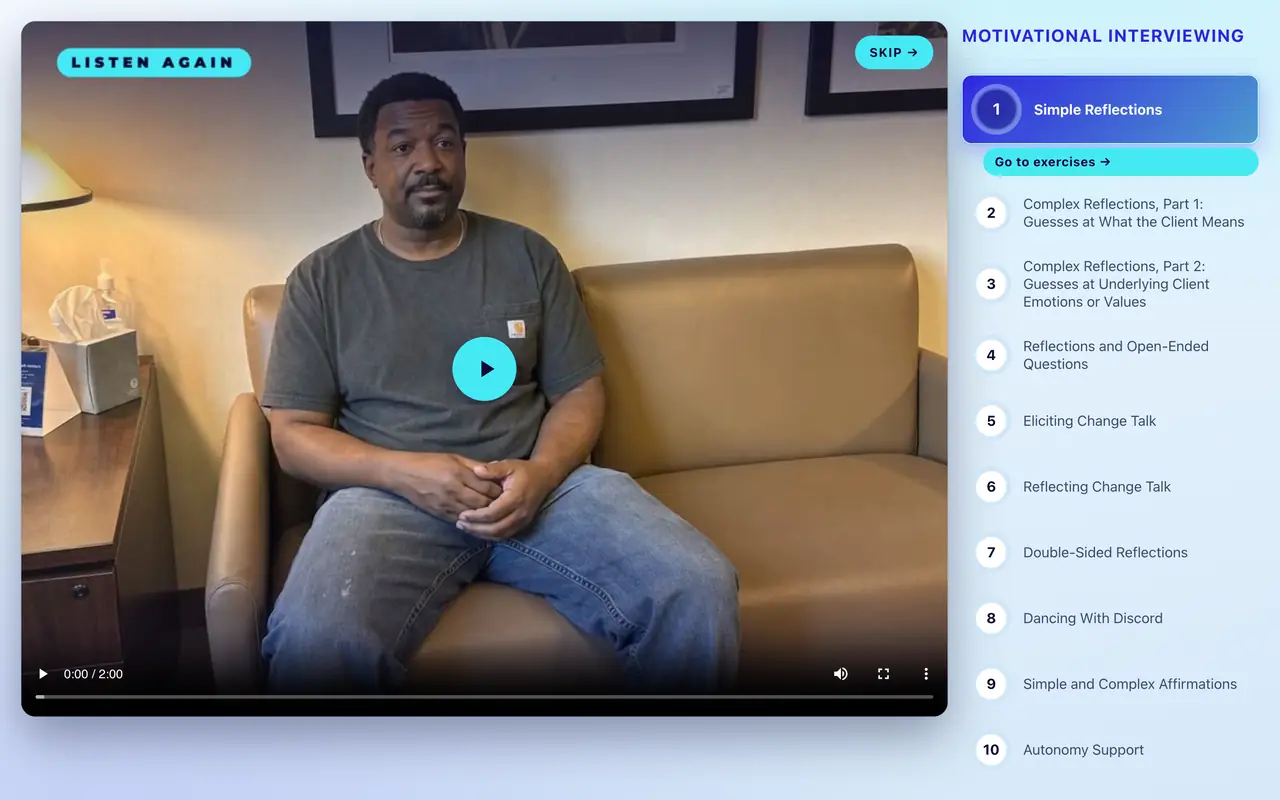
Motivational Interviewing (MI) is, in its founders' words, "a particular way of talking with people about change and growth to strengthen their own motivation and commitment" (Miller and Rollnick, 2023), and it was built for ambivalence, when part of someone wants to drink less, quit smoking or stick with a treatment and part of them doesn't. The Motivational Interviewing course on PracticeTherapy.ai trains ten of its core skills, one at a time, in 150 short exercises: a video client says a line, you answer out loud, and an AI voice coach tells you right away whether your answer met the skill's criteria.
The ten skills are the first ten exercises of Deliberate Practice in Motivational Interviewing (Manuel, Ernst, Vaz and Rousmaniere, 2022), one of the American Psychological Association's deliberate practice books, in the book's order. Motivational Interviewing is a private beta course on the site, so it needs an invite code.
- Simple Reflections
- Complex Reflections, Part 1: Guesses at What the Client Means
- Complex Reflections, Part 2: Guesses at Underlying Client Emotions or Values
- Reflections and Open-Ended Questions
- Eliciting Change Talk
- Reflecting Change Talk
- Double-Sided Reflections
- Dancing With Discord
- Simple and Complex Affirmations
- Autonomy Support
What is Motivational Interviewing built on?
The psychologist William Miller developed MI in the early 1980s, out of his work in addiction treatment, as an alternative to the confrontational style that dominated addiction clinics at the time, and then refined it with Stephen Rollnick (Manuel and colleagues, 2022). It started with alcohol and drugs and now covers exercise and healthy eating, as well as vaccination and taking treatment as prescribed, in medical, mental health, criminal justice and school settings (Manuel and colleagues, 2022).
It stands on two foundations, one clinical and one from research. The first is the client-centered psychology of Carl Rogers (Miller and Moyers, 2017): the client is the expert on their own life, and in the book's words, "Clients have everything they need, all of the wisdom and strength needed to move toward health" (Manuel and colleagues, 2022). The second is research that codes recorded sessions (Miller and Rose, 2009). From that research, Miller and Moyers (2021) first show that what clients say in sessions predicts what they do later, which alone could mean, in their words, that "we might be measuring the smoke (client language) instead of the fire (motivation) that produced it." "What is more telling is the second step," they write, and it shows that what counselors say alters what clients say, in experiments that assigned counselors' styles randomly and in sessions in which therapists turned styles on and off with the same client (Miller, Benefield and Tonigan, 1993; Glynn and Moyers, 2010; Patterson and Forgatch, 1985).
The 2022 practice book says these skills count as MI only when used in its spirit, a "way of being" with a client made of collaboration, acceptance, evocation and compassion, which "may feel very natural to some clinicians; for others, it may take a period of sustained practice before it feels comfortable" (Manuel and colleagues, 2022). Without that spirit, it warns, the techniques "are like a series of notes without the 'music'" and can seem like a way to trick people into changing (Manuel and colleagues, 2022). In their 2023 fourth edition, MI's founders broadened evocation into empowerment, affirming clients' own strengths and autonomy, and kept partnership, acceptance and compassion (Miller and Rollnick, 2023).
How does Motivational Interviewing help people change?
By letting people talk themselves into it. MI "allows the client the opportunity to talk themselves into change" (Manuel and colleagues, 2022). Miller and Moyers (2021) trace the idea to Daryl Bem's self-perception theory, that people learn what they believe partly by hearing themselves say it. They summarize it in three words: "Spoken words matter."
MI listens for two kinds of talk. In the practice book, change talk "includes language moving toward a specific behavioral change," and sustain talk, anything a client says in favor of staying the same, comes in the same six kinds as change talk: reasons, desire, ability, need, commitment and taking steps (Manuel and colleagues, 2022). In the practice book's smoking examples, "I am spending too much money on cigarettes" is a reason to change, and "I like taking smoke breaks with my friends at work" is a reason too, for remaining the same.
"Ambivalent clients will naturally offer both change and sustain talk," the book says, and MI treats ambivalence, feeling two ways about a change, as an expected part of changing a long-standing habit, so a client who says both is stuck and hasn't failed (Manuel and colleagues, 2022). The book has you pick a change you have been considering and then asks: "How would you feel if someone told you the top five reasons you should make this change?" The harder a clinician argues for change, the more an ambivalent client argues the other side, and change gets less likely as the sustain talk adds up (Manuel and colleagues, 2022).
In a meta-analysis of 36 studies with 3,025 participants, a higher share of change talk relative to sustain talk predicted better outcomes and higher amounts of sustain talk predicted worse ones (Magill and colleagues, 2018), and two earlier meta-analyses found the same for sustain talk (Magill and colleagues, 2014; Pace and colleagues, 2017). Trainee counselors who alternated between drawing out change talk and a neutral interview increased the share of change talk whenever they drew it out (Glynn and Moyers, 2010), and in a randomized trial, training substance use providers to respond to client language led their clients to engage in less sustain talk in real sessions (Moyers and colleagues, 2017).
Does Motivational Interviewing work?
By 2022 more than 1,900 controlled trials of MI had been published, along with more than 200 meta-analyses and systematic reviews, and "Between two-thirds and three-quarters of clinical trials have reported significant benefits of MI" (Miller, 2023), so the answer is yes, with modest and lasting effects for many problems.
A meta-analysis of 119 studies found that MI did better than weak comparisons, such as a waiting list or written material, with a small effect that held at follow-ups of up to a year, and about as well as other active treatments such as cognitive behavioral therapy and 12-step counseling, in less time: "the MI interventions took over 100 fewer minutes of treatment on average yet produced equal effects" (Lundahl and colleagues, 2010). A review of 104 reviews found moderate-quality evidence of small benefits, mainly for drinking, other substance use and physical activity (Frost and colleagues, 2018). An earlier review found larger effects in studies with mostly ethnic minority clients, and wide differences between clinicians (Hettema, Steele and Miller, 2005).
Who delivers it matters. In 95 recorded brief alcohol interventions, counselors with better MI skills had clients who drank less at one year, and avoiding responses inconsistent with MI, like confrontation, was more important than including MI-consistent ones (Gaume and colleagues, 2009). MI is not for everyone: in several trials, individuals who were already ready to change did worse with it, and the founders of MI suggest that in those cases, it is best to proceed directly to planning (Miller and Rollnick, 2023).
Why practice Motivational Interviewing one skill at a time?
Because MI looks simple and is hard to do. The book's lead author describes her first role-play as a graduate student: her reflections came out sounding like questions, and she was so busy deciding whether to reflect or to ask that she barely heard her client (Manuel and colleagues, 2022). Learners tend to overestimate their MI skill before training and underestimate it afterward (Hartzler and colleagues, 2007), most clinicians are not reliable judges of their own MI (Miller and colleagues, 2004), and without ongoing coaching and feedback the skills fade, as clinicians drift back to asking questions instead of reflecting (Schwalbe, Oh and Zweben, 2014; Manuel and colleagues, 2022).
Repetition with feedback is the classic remedy. MI workshops have long had trainees offer reflection after reflection to "build their MI muscle," and they deliberately limit what trainees may say, only reflections or only open questions, so a new skill feels comfortable before it is combined with others (Manuel and colleagues, 2022). In a controlled trial comparing a deliberate practice workshop with a traditional workshop for MI skills, both groups were equally satisfied, but the deliberate practice group performed better when observed and, four months later, was rated more empathic (Westra and colleagues, 2021).
The course follows that format. Each skill has 15 exercises, five each at beginner, intermediate and advanced level. A video client says one line, you answer out loud, and the coach checks a transcript of your words against the skill's criteria. You need to meet all criteria that apply in order to pass. The screen shows the skill's criteria, a good example answer and an example of a common mistake. If you miss, the coach names the criterion you missed, and the client says the line again. How an exercise works step by step is in Can you practice therapy skills on your own?, the research behind the method is in What is deliberate practice for therapists?, and what the coach judges is in What can't an AI coach hear?.
Why do we reflect in Motivational Interviewing?
Skill 1: Simple Reflections. A simple reflection says back to the client what was just said, in the form of a statement, and adds nothing of your own. There is no question, no opinion, advice or information, and no guess at meaning yet. To "My drinking has increased in the past year," the model reflection is as short as "You're drinking more than you used to" (Manuel and colleagues, 2022).
Reflections are the principal means MI practitioners use to demonstrate empathy. Accurate empathy is regarded by Miller and Moyers (2021) as the therapist quality most consistently associated with better outcomes. A moderately strong association was reported in a meta-analysis of 82 samples that included more than 6,000 clients (Elliott and colleagues, 2018). A reflection allows the client to be with their experience and look more closely, without having to deal with the advice, reassurance and warnings that a psychologist named Thomas Gordon called roadblocks, responses that clients have to get around before they can think further (Miller and Moyers, 2021). It is said as a statement because a rising tone turns it into a request to confirm or explain, and clients tend to back away from what they said (Miller and Moyers, 2021): "You're feeling anxious?" and "You're feeling anxious." do different things.
Beginners allow the reflection to rise like a question, work in some advice, or tack on "Is that right?" (Manuel and colleagues, 2022). Twelve of the course's 19 examples of common mistakes for this skill are labeled "Asked a question" or "Question + advice", like this one to a client who drinks about a six-pack of beer a day: "Have you tried switching to a lighter beer with fewer calories?" Skills 1 to 3 use almost the same 15 client lines, so that client comes back in skill 2, where the model answer is "Beer is a big part of your life," and in skill 3, where it's "You're worried about your drinking." The first criterion for this skill ends "There is no inflection at the end of the reflection," and that part is yours to practice, since the coach reads a transcript of your words and can't hear your pitch. Speech-to-text can turn a statement into a question, so a reflection in statement order doesn't count as a question just because it ends on a question mark.
Why guess at what the client means instead of repeating it?
Skill 2: Complex Reflections, Part 1: Guesses at What the Client Means. Complex reflections offer as a statement your best guess at what the client means but has not quite said, and they still leave out opinions, advice and information. For the client whose drinking has increased, the model answer moves to "You're really noticing a difference" (Manuel and colleagues, 2022).
Reflective listening isn't the same as echoing what the client said. Miller and Moyers (2021) describe a skillful reflection as a gentle guess at what has not yet been said, almost the next sentence in the client's own paragraph. Often the unsaid meaning is one of the client's own reasons for change, as when a client whose children want them to quit smoking hears that they want to be a good role model (Manuel and colleagues, 2022). In an MI intervention for alcohol misuse and sexual risk behavior with 132 adults seen in two emergency departments, complex reflections and open questions went with clients shifting from arguing against change to arguing for it, while simple reflections tended to keep clients going in the direction they were already headed (Laws and colleagues, 2018). Miller and Rollnick (2023) suggest the arc for a live session: "It's common to start off with a simpler reflection, but try moving to more complex reflections as you listen to understand."
Your guess doesn't need to be correct. Most clients take a reflection as a sincere effort to understand them, and will correct you (Manuel and colleagues, 2022). This is different from an interpretation, which Miller and Moyers (2021) list as one of the roadblocks to listening. A complex reflection offers the client's own possible meaning and allows them to judge.
Of the course's 19 examples of common mistakes for this skill, 9 are labeled "Question + advice" or "Asked a question", 3 are "Lecturing" and 2 are "Simple, not complex", the client's own words handed back with nothing added. The skill's first criterion is "The clinician guesses at a deeper meaning in the client's words," and the coach gives credit for anything you add that the client did not put into words, such as what the habit costs them or what they want or fear, even when the guess turns out to be off.
Why reflect a feeling or value the client hasn't said?
Skill 3: Complex Reflections, Part 2: Guesses at Underlying Client Emotions or Values. This reflection names, as a statement, the feeling or the value under the client's words. For the client whose drinking has increased, it might be "You're concerned about this increase in your drinking" (Manuel and colleagues, 2022).
These reflections can be especially powerful in MI because they bring the client's values to the foreground, such as being healthy or a good parent or partner, and the ways a habit is not in line with those values (Manuel and colleagues, 2022). "When you understand what people value, you have a key to what motivates them," write Miller and Rollnick (2023), and helping people voice their values can work like self-affirmation, which lowers defensiveness. Outside counseling, a meta-analysis of 144 experiments found small but reliable improvement in acceptance of health messages, intentions to change and later behavior as a result of participants reflecting on their most important values (Epton and colleagues, 2015).
The feeling does not have to be exactly right: "Complete accuracy is not necessary when reflecting a client's emotions" (Manuel and colleagues, 2022). Getting the intensity right matters more. A reflection that is stronger than the feelings the client was expressing, like reflecting "furious" rather than "upset," tends to make them back away, while one at or a little below their level keeps them exploring (Miller and Moyers, 2021).
Four of the course's 19 examples of common mistakes for this skill are labeled "Missed the emotion", and nine more ask a question, with or without advice, like this one to a client who'd like to exercise more and hates the way they look and feel: "What is it about the way you look that bothers you the most?" The coach looks for a word or phrase in your reply that names how the client feels, however mild or imperfectly chosen, as in the model answer "You're frustrated and want to change," and a wrong guess still counts as a guess. Naming a habit, a difficulty or a judgment about the behavior doesn't count.
Why follow a reflection with an open question?
Skill 4: Reflections and Open-Ended Questions. Your answer is a reflection, simple or complex, followed by an open question that invites more than a one-word answer, often starting with "what," "why" or "how." To a client who says they haven't vaped for a long time, the model answer reflects the break, "You've taken a break from vaping," and then asks, "What are your thoughts about vaping?" (Manuel and colleagues, 2022).
The reflection shows understanding while the question invites the client to share their own thoughts, ideas and strategies (Manuel and colleagues, 2022). Questions work best on a foundation of reflections. Beginning MI clinicians aim for about as many reflections as questions and advanced ones for about twice as many (Manuel and colleagues, 2022), or as Miller and Rollnick (2023) put it, "A guideline we suggest is to offer two reflections for each question you ask." Open questions also help a client who is stuck: along with complex reflections, they went with clients shifting from sustain talk to change talk (Laws and colleagues, 2018).
Beginners ask closed questions that can be answered with a yes or a no, such as the course's example of the mistake, "Have you thought about whether you might go back to vaping at some point?" Others reflect and stop, with no question. In a live session, leave a pause after a reflection. Rushing to ask a question takes away the client's opportunity to answer (Manuel and colleagues, 2022).
How do you ask questions that invite change talk?
Skill 5: Eliciting Change Talk. Here you ask a single evocative, open-ended question, and the client's honest answer to it should be their own case for change. To a client who drinks about a six-pack of beer a day, a model answer is "What, if anything, don't you like about your drinking?" The criteria name four kinds of question that do this, about concerns, downsides, how the client would like things to be different, or why they might want to change. The question must not pull for sustain talk or neutral facts, and it can't include your opinion, advice or information.
The idea is for the client to make the argument for change. Evocation assumes that clients already have strengths and expertise of their own, and that they are active partners in their own change. This is in contrast to an approach in which the practitioner is the expert and the client simply receives that expertise (Miller and Moyers, 2021). The specific wording of a question steers its answer. The book gives an example of asking a mother why she does not want to change her drinking, which drew a defense of her parenting. When asked why she might want to change, the mother voiced her wish to be a good mother (Manuel and colleagues, 2022). Questions gathering data on how much, how often or since when yield neutral facts that carry no motivation either way (Manuel and colleagues, 2022).
Beginners most often ask the wrong sort of question, for example why the client hasn't been able to stop. This draws a list of reasons not to change, and it is the most common mistake in the course's examples for this skill. If a good question draws an answer other than change talk anyway, this is normal; reflect what you heard, or try asking another evocative question (Manuel and colleagues, 2022).
For the second criterion, the coach imagines the client answering your question in one honest sentence, and if that sentence would be about what the habit does for them or what they'd lose by changing, the question pulls for sustain talk, however warmly it's put. Six of the course's 15 examples of common mistakes for this skill are labeled "Elicits sustain talk", like this one to the client who drinks about a six-pack of beer a day: "What do you enjoy most about having those beers every day?"
Why reflect only the change talk?
Skill 6: Reflecting Change Talk. When a client says something mixed, part for change and part for staying the same, you reflect only the part that leans toward change, with a simple or a complex reflection. To "The blackouts scare me. I know I should do something about my drinking. I really like drinking though," a simple reflection of the change talk is "The blackouts scare you" (Manuel and colleagues, 2022).
You can't reflect everything. Whatever you reflect tends to bring more of the same, and MI, as a method, purposefully chooses what it reflects (Miller and Moyers, 2021). This skill relies on some of MI's most direct research, which showed that in sessions coded utterance by utterance, MI-style responses were more often followed by client statements in favor of change (Moyers and Martin, 2006). In 118 coded sessions, after a therapist reflected change talk, the client's next statement was change talk 44% of the time, more than chance would predict: "What therapists reflect, they will hear more of" (Moyers and colleagues, 2009).
Is that manipulative? MI's founders consider steering toward a change fair when it is what the client wants or the stated purpose of the service the client chose, or when health or safety is at stake, as on a suicide prevention hotline. When the choice is the person's alone, such as whether to have children, they say to remain neutral, and "Directional evoking is inappropriate when the change you favor is in your own interest or that of the system in which you work, but may or may not be in your client's best interest" (Miller and Rollnick, 2023). Miller (1994) called MI "a middle way between passivity and coercion." Timing matters too. Early in a session, reflecting some sustain talk helps your client feel understood, and if you ignore it completely, the client can feel pushed (Manuel and colleagues, 2022).
Twelve of the course's 18 examples of common mistakes for this skill are labeled "Reflects sustain talk", and the coach counts a reflection as a miss if any part of it carries the keep-things-as-they-are side. The advanced lines hide a small piece of change talk inside irritation aimed at you, like "I don't want to get a DUI again, but my drinking isn't a big problem. You're probably going to tell me to quit, but I don't need to."
Why reflect both sides of a client's ambivalence?
Skill 7: Double-Sided Reflections. You reflect the sustain talk first and the change talk last, joined by "and," never by "but." To a client who loves an afternoon soda as a little treat and knows it isn't good for them, the model answer is "Your afternoon soda is a treat for you, and you're worried about how it may be affecting you" (Manuel and colleagues, 2022).
A client may feel misunderstood or pushed if they only hear their change talk reflected, since ambivalence is normal. Doing a double-sided reflection shows that both sides are understood and still gives change talk the last word (Manuel and colleagues, 2022). The order comes from what clients do next: "With double-sided reflections, people are more likely to respond to what you said last, and thereby amplify that side of their ambivalence" (Miller and Rollnick, 2023). And "but" undoes the first half, since it is "a bit like an eraser, discounting what precedes it" (Miller and Rollnick, 2023).
Beginners end on the sustain talk, join the halves with "but," or reflect only one side. The most common mistake in the course's examples for this skill is to jump to advice. The hardest lines invite advice, with a client asking directly what they should do. The skill is to reflect anyway.
What do you say when a client pushes back at you?
Skill 8: Dancing With Discord. When a client's frustration is aimed at you or at the process, you reflect it, simply or with a complex reflection, and you do not argue, confront, shame, teach or persuade. To a client fed up that you are the third person that day to ask about their smoking, a model answer is "You're tired of being asked about your smoking" (Manuel and colleagues, 2022).
Discord is not the same as sustain talk. "Whereas sustain talk is about the problem or change focus, discord is about you as the helper" (Miller and Rollnick, 2023): "You can't understand how hard it is to quit drinking" is discord, and "It is impossible to quit drinking" is sustain talk (Manuel and colleagues, 2022). MI's founders stopped calling this "resistance" in their 2013 third edition, partly because the word seemed to blame the client and partly because it depends so much on the clinician: "Resistance is interpersonal; it always requires at least two people" (Miller and Rollnick, 2023; Miller, 2023). In good MI, the book says, clinician and client look like they are dancing; discord is the moment the dance turns into wrestling (Manuel and colleagues, 2022).
Arguing back makes it worse. In a small randomized trial with 42 problem drinkers, a confrontational style drew more resistance, that resistance predicted more drinking a year later, and the authors summed up the one therapist behavior that predicted it: "the more the therapist confronted, the more the client drank" (Miller, Benefield and Tonigan, 1993). Defensiveness rises and falls with the therapist's style "like the volume control of a radio" (Miller and Moyers, 2021). Briefly, reflect what the client feels toward you. Some of the book's model answers are just a short sentence, such as "You don't feel heard right now." If you've gotten ahead of the client, let the client know and hand the decision back to them (Manuel and colleagues, 2022).
Beginners defend themselves or the clinic, or argue the point, and those are the most common mistakes in the course's examples for this skill. The client lines climb from complaints about the process, such as a long intake form, to challenges of your competence, such as how old you are or whether you have ever used pot.
Why affirm clients in Motivational Interviewing?
Skill 9: Simple and Complex Affirmations. You notice something real and good in what the client did or who they are and name it, specifically and sincerely. Beginner lines call for simple affirmations, which show appreciation or encourage the client's effort; intermediate and advanced lines call for complex affirmations, which name the deeper meaning of a strength or ability.
Affirmations put positive regard into words and show clients strengths they may not see in themselves (Manuel and colleagues, 2022). Across 64 studies, therapists' positive regard for their clients had a small positive link with outcomes (Farber, Suzuki and Lynch, 2018), and in coded MI sessions affirming had an unusual double effect: "Affirm was the only therapist behavior that both increased change talk and also reduced sustain talk" (Apodaca and colleagues, 2016). Affirmation also tends to lower defensiveness, which makes hard information easier to consider (Miller and Moyers, 2021).
An affirmation is not praise. Miller and Moyers (2021) advise starting with "you" rather than "I," because "I'm proud of you" is an evaluation and turns the focus to the therapist. Choose what you affirm with care, too: "Be conscious of whatever you're affirming because you're likely to get more of it" (Miller and Rollnick, 2023). The book compares simple affirmations to frosting on a cake: too little and the cake is dry, too much and it is sickly sweet (Manuel and colleagues, 2022). Affirming works differently in Accelerated Experiential Dynamic Psychotherapy (AEDP), often through the therapist's own delight.
Most of the course's 21 examples of common mistakes for this skill are a question (7) or a question plus advice (5) instead of an affirmation. Beginners also overuse affirmations until they sound hollow. They keep them vague, or they give a simple one when a complex one is called for. The course's examples of common mistakes add backhanded affirmations and minimizing. One example shows the difference. A client who drank after almost a year sober says they guess they will always be a drunk, and the complex affirmation does not argue; it says they have put so much time and effort into their sobriety and want it to count for something (Manuel and colleagues, 2022).
Why support the client's autonomy?
Skill 10: Autonomy Support. You hand the decision back to the client, on beginner lines with "an explicit statement regarding autonomy, personal choice, or control", while intermediate lines call for "a question that asks for the client to consider choices or determine the course" and advanced ones for "a reflection that emphasizes the client's sense of choice", each harder than the last, with no "advice, opinions, or other directive responses that could reduce the client's sense of autonomy" on any line (Manuel and colleagues, 2022). To the client whose family keeps pressuring them to quit smoking, the model answer is "Your family can pressure you, but in the end, it is really up to you what, if anything, you do about your smoking."
"Freedom to choose is not something that you can grant to your clients. They already have it," write Miller and Moyers (2021), and saying so is simply telling the truth (Miller and Moyers, 2021). Miller and Moyers (2021) describe psychological reactance as "a well-documented tendency for people to act contrary to uninvited persuasion and advice, even if they agree with it," and the research fits. In alcohol treatment, clients who tend to resist pressure drank more a year later when their therapists were more directive (Karno and Longabaugh, 2005). Across 13 studies, reflective and nondirective therapists worked better for this type of client (Beutler, Edwards and Someah, 2018).
Self-determination theory, a well-tested theory that change lasts longer when it comes from one's own motivation, provides the framework, and a paper written with Richard Ryan, one of the founders of self-determination theory, and Stephen Rollnick, one of the founders of MI, puts it plainly: "Autonomy support is inherent in all the principles of motivational interviewing" (Markland and colleagues, 2005). Across 73 studies, health programs based on the theory that provides this framework brought modest gains in health behavior (Ntoumanis and colleagues, 2021).
Supporting autonomy does not mean having no view. To a client who wants to get their diabetes under control but says it can feel overwhelming, the model answer is "I can share my thoughts, and it will be up to you to decide what, if any, changes you make." You can still share information after seeking permission, which clients almost always grant and which "can lower the shields of defensiveness" (Miller and Moyers, 2021).
Sixteen of the course's 18 examples of common mistakes for this skill are labeled "Took away choice" or "Directive advice", and beginners take the choice away without realizing it, as in this well-intended "you really should" to a client whose doctor says they have no choice but to quit smoking: "Your doctor is the expert, so if she says you have to quit, you really should listen to her." Many lines come from clients who feel cornered by a husband who threatens to take the kids, a doctor who says they have to quit, an employer that wants to mandate vaccination, or a court. To one who says "It was here or jail," the model answer turns that pressure into a choice the client owns: "It seems that you have chosen to come here instead of going to jail. How did you make that decision?"
 Private beta
Motivational Interviewing
Ten skills for helping clients talk themselves into change, practiced out loud with an AI voice coach.
About the author

Sources
- Apodaca, T. R., Jackson, K. M., Borsari, B., Magill, M., Longabaugh, R., Mastroleo, N. R., & Barnett, N. P. (2016). Which individual therapist behaviors elicit client change talk and sustain talk in motivational interviewing? Journal of Substance Abuse Treatment, 61, 60-65. https://doi.org/10.1016/j.jsat.2015.09.001
- Beutler, L. E., Edwards, C., & Someah, K. (2018). Adapting psychotherapy to patient reactance level: A meta-analytic review. Journal of Clinical Psychology, 74(11), 1952-1963. https://doi.org/10.1002/jclp.22682
- Elliott, R., Bohart, A. C., Watson, J. C., & Murphy, D. (2018). Therapist empathy and client outcome: An updated meta-analysis. Psychotherapy, 55(4), 399-410. https://doi.org/10.1037/pst0000175
- Epton, T., Harris, P. R., Kane, R., van Koningsbruggen, G. M., & Sheeran, P. (2015). The impact of self-affirmation on health-behavior change: A meta-analysis. Health Psychology, 34(3), 187-196. https://doi.org/10.1037/hea0000116
- Farber, B. A., Suzuki, J. Y., & Lynch, D. A. (2018). Positive regard and psychotherapy outcome: A meta-analytic review. Psychotherapy, 55(4), 411-423. https://doi.org/10.1037/pst0000171
- Frost, H., Campbell, P., Maxwell, M., O'Carroll, R. E., Dombrowski, S. U., Williams, B., Cheyne, H., Coles, E., & Pollock, A. (2018). Effectiveness of motivational interviewing on adult behaviour change in health and social care settings: A systematic review of reviews. PLOS ONE, 13(10), e0204890. https://doi.org/10.1371/journal.pone.0204890
- Gaume, J., Gmel, G., Faouzi, M., & Daeppen, J.-B. (2009). Counselor skill influences outcomes of brief motivational interventions. Journal of Substance Abuse Treatment, 37(2), 151-159. https://doi.org/10.1016/j.jsat.2008.12.001
- Glynn, L. H., & Moyers, T. B. (2010). Chasing change talk: The clinician's role in evoking client language about change. Journal of Substance Abuse Treatment, 39(1), 65-70. https://doi.org/10.1016/j.jsat.2010.03.012
- Hartzler, B., Baer, J. S., Dunn, C., Rosengren, D. B., & Wells, E. (2007). What is seen through the looking glass: The impact of training on practitioner self-rating of motivational interviewing skills. Behavioural and Cognitive Psychotherapy, 35(4), 431-445. https://doi.org/10.1017/S1352465807003712
- Hettema, J., Steele, J., & Miller, W. R. (2005). Motivational interviewing. Annual Review of Clinical Psychology, 1, 91-111. https://doi.org/10.1146/annurev.clinpsy.1.102803.143833
- Karno, M. P., & Longabaugh, R. (2005). Less directiveness by therapists improves drinking outcomes of reactant clients in alcoholism treatment. Journal of Consulting and Clinical Psychology, 73(2), 262-267. https://doi.org/10.1037/0022-006X.73.2.262
- Laws, M. B., Magill, M., Mastroleo, N. R., Gamarel, K. E., Howe, C. J., Walthers, J., Monti, P. M., Souza, T., Wilson, I. B., Rose, G. S., & Kahler, C. W. (2018). A sequential analysis of motivational interviewing technical skills and client responses. Journal of Substance Abuse Treatment, 92, 27-34. https://doi.org/10.1016/j.jsat.2018.06.006
- Lundahl, B. W., Kunz, C., Brownell, C., Tollefson, D., & Burke, B. L. (2010). A meta-analysis of motivational interviewing: Twenty-five years of empirical studies. Research on Social Work Practice, 20(2), 137-160. https://doi.org/10.1177/1049731509347850
- Magill, M., Apodaca, T. R., Borsari, B., Gaume, J., Hoadley, A., Gordon, R. E. F., Tonigan, J. S., & Moyers, T. (2018). A meta-analysis of motivational interviewing process: Technical, relational, and conditional process models of change. Journal of Consulting and Clinical Psychology, 86(2), 140-157. https://doi.org/10.1037/ccp0000250
- Magill, M., Gaume, J., Apodaca, T. R., Walthers, J., Mastroleo, N. R., Borsari, B., & Longabaugh, R. (2014). The technical hypothesis of motivational interviewing: A meta-analysis of MI's key causal model. Journal of Consulting and Clinical Psychology, 82(6), 973-983. https://doi.org/10.1037/a0036833
- Manuel, J. K., Ernst, D., Vaz, A., & Rousmaniere, T. (2022). Deliberate practice in motivational interviewing. American Psychological Association. https://doi.org/10.1037/0000297-000
- Markland, D., Ryan, R. M., Tobin, V. J., & Rollnick, S. (2005). Motivational interviewing and self-determination theory. Journal of Social and Clinical Psychology, 24(6), 811-831. https://doi.org/10.1521/jscp.2005.24.6.811
- Miller, W. R. (1994). Motivational interviewing: III. On the ethics of motivational intervention. Behavioural and Cognitive Psychotherapy, 22(2), 111-123. https://doi.org/10.1017/S1352465800011905
- Miller, W. R. (2023). The evolution of motivational interviewing. Behavioural and Cognitive Psychotherapy, 51(6), 616-632. https://doi.org/10.1017/S1352465822000431
- Miller, W. R., Benefield, R. G., & Tonigan, J. S. (1993). Enhancing motivation for change in problem drinking: A controlled comparison of two therapist styles. Journal of Consulting and Clinical Psychology, 61(3), 455-461. https://doi.org/10.1037/0022-006X.61.3.455
- Miller, W. R., & Moyers, T. B. (2017). Motivational interviewing and the clinical science of Carl Rogers. Journal of Consulting and Clinical Psychology, 85(8), 757-766. https://doi.org/10.1037/ccp0000179
- Miller, W. R., & Moyers, T. B. (2021). Effective psychotherapists: Clinical skills that improve client outcomes. Guilford Press.
- Miller, W. R., & Rollnick, S. (2023). Motivational interviewing: Helping people change and grow (4th ed.). Guilford Press.
- Miller, W. R., & Rose, G. S. (2009). Toward a theory of motivational interviewing. American Psychologist, 64(6), 527-537. https://doi.org/10.1037/a0016830
- Miller, W. R., Yahne, C. E., Moyers, T. B., Martinez, J., & Pirritano, M. (2004). A randomized trial of methods to help clinicians learn motivational interviewing. Journal of Consulting and Clinical Psychology, 72(6), 1050-1062. https://doi.org/10.1037/0022-006X.72.6.1050
- Moyers, T. B., Houck, J., Glynn, L. H., Hallgren, K. A., & Manuel, J. K. (2017). A randomized controlled trial to influence client language in substance use disorder treatment. Drug and Alcohol Dependence, 172, 43-50. https://doi.org/10.1016/j.drugalcdep.2016.11.036
- Moyers, T. B., & Martin, T. (2006). Therapist influence on client language during motivational interviewing sessions. Journal of Substance Abuse Treatment, 30(3), 245-251. https://doi.org/10.1016/j.jsat.2005.12.003
- Moyers, T. B., Martin, T., Houck, J. M., Christopher, P. J., & Tonigan, J. S. (2009). From in-session behaviors to drinking outcomes: A causal chain for motivational interviewing. Journal of Consulting and Clinical Psychology, 77(6), 1113-1124. https://doi.org/10.1037/a0017189
- Ntoumanis, N., Ng, J. Y. Y., Prestwich, A., Quested, E., Hancox, J. E., Thøgersen-Ntoumani, C., Deci, E. L., Ryan, R. M., Lonsdale, C., & Williams, G. C. (2021). A meta-analysis of self-determination theory-informed intervention studies in the health domain: Effects on motivation, health behavior, physical, and psychological health. Health Psychology Review, 15(2), 214-244. https://doi.org/10.1080/17437199.2020.1718529
- Pace, B. T., Dembe, A., Soma, C. S., Baldwin, S. A., Atkins, D. C., & Imel, Z. E. (2017). A multivariate meta-analysis of motivational interviewing process and outcome. Psychology of Addictive Behaviors, 31(5), 524-533. https://doi.org/10.1037/adb0000280
- Patterson, G. R., & Forgatch, M. S. (1985). Therapist behavior as a determinant for client noncompliance: A paradox for the behavior modifier. Journal of Consulting and Clinical Psychology, 53(6), 846-851. https://doi.org/10.1037/0022-006X.53.6.846
- Schwalbe, C. S., Oh, H. Y., & Zweben, A. (2014). Sustaining motivational interviewing: A meta-analysis of training studies. Addiction, 109(8), 1287-1294. https://doi.org/10.1111/add.12558
- Westra, H. A., Norouzian, N., Poulin, L., Coyne, A., Constantino, M. J., Hara, K., Olson, D., & Antony, M. M. (2021). Testing a deliberate practice workshop for developing appropriate responsivity to resistance markers. Psychotherapy, 58(2), 175-185. https://doi.org/10.1037/pst0000311