
Can you practice therapy skills on your own?
Yes. On PracticeTherapy.ai you watch a client video, answer out loud and hear a voice coach's feedback right away. How it works, and what the research says.
Yes, you can. Practicing alone is a recognized part of deliberate practice, which means rehearsing one specific skill again and again with feedback each time. PracticeTherapy.ai is a free deliberate practice platform for mental health professionals (therapists, social workers, psychologists, etc.) to learn new clinical skills on their own. Each exercise is a short video of a simulated client saying one thing to you. You respond out loud, and an AI voice coach gives you feedback about how well you did, which of the skill's criteria (the few specific things a good answer does) weren't met, and hints along the way. Think of each exercise as a shot from the free throw line. The work of basketball is playing real games, but people still stand at the free throw line and practice, and this site solves for practice.
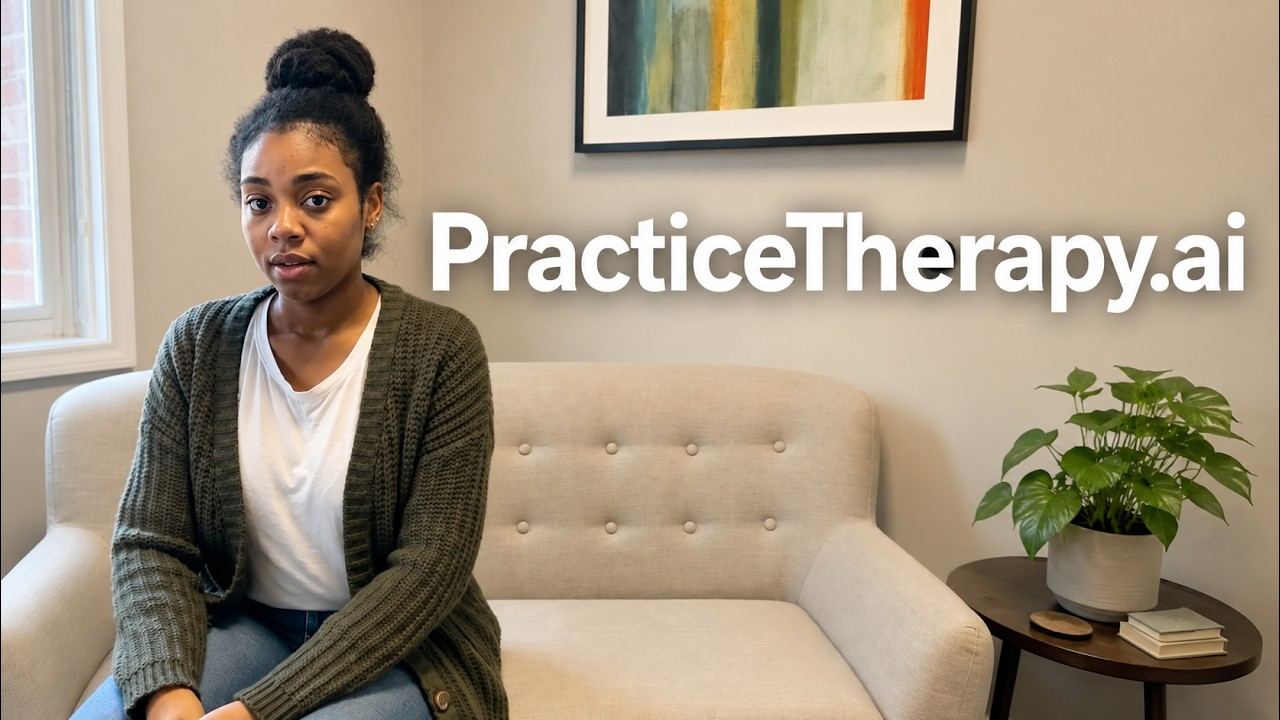
In this demo, Justin practices Common Factors Therapy on the site.
How does practicing on PracticeTherapy.ai work?
You sign up with an email and a password, with no invite code needed, and choose a course. Common Factors Therapy and Trauma-Informed Therapy are open to everyone. Motivational Interviewing, Facilitative Interpersonal Skills and Accelerated Experiential Dynamic Psychotherapy are in private beta.
A course is a set of skills that you practice one at a time. Common Factors Therapy has 9 of them, from Empathic Conjecture to Deepening Emotional Experience, and with 15 exercises per skill that's 135 exercises. A path on the course page shows how many of each skill's exercises you've completed.
What happens in one exercise?
Take Empathic Conjecture, the first Common Factors Therapy skill. It opens with a short intro video that teaches the skill and its three criteria, the first of which is to start each response with "It sounds like you're feeling". I really wanted to let the client video shine, so we kept the intro videos short. In one beginner exercise the client says "Sometimes, I feel like no one actually gives a damn about what I'm dealing with." Those words are on the screen too, along with the criteria, a good example ("It sounds like you're feeling lonely and ignored, like no one really cares about what's going on with you.") and a common mistake labeled "Asked a question" ("Have you told the people around you that you feel this way?").
The client's video plays on its own and you answer out loud, as you would in a session. Say you answer "Have you told anyone how you feel?" That misses the criteria, so the coach tells you which one in a short piece of feedback ending with "try again", the criterion turns red on the screen and the client says the line again. Miss a second time and the coach adds what you got right, why the answer missed, and "Try saying:" followed by the textbook answer. A third miss gets a suggestion to take a break, though nothing stops you from trying again or pressing Next exercise. Pass, and the coach names the specific thing you did well. What it heard you say shows on screen under "You said", and you can repeat any exercise as often as you like. An answer passes only if it meets every criterion that applies to it.
Getting the coach's feedback right was the important part, because it would've been frustrating to criticize a correct response. How the coach was tuned and tested is in Can an AI coach judge therapy responses accurately?.
How do you go from beginner to advanced?
The 15 exercises in each skill get harder as you go, 5 beginner, then 5 intermediate, then 5 advanced, and the last exercise of the last skill takes considerably more technical mastery than the first one. It's like learning the violin, where you start out playing one scale, then more scales, then full composed pieces. The idea is to keep you in what's called the zone of proximal development, where practice is never too easy and never too hard. The site keeps track of which exercises you've passed, and when you open a course again it takes you back to the last skill you practiced. It has no leaderboards, achievements or points.
How long does it take, and what do you need?
About 37 seconds per round on average, from the client's video to your answer, which puts a whole skill of 15 exercises at about 10 minutes. You can do this whenever you want, on a phone, tablet or computer with a recent web browser. The voice coach uses ElevenLabs voice agents for transcription and speech, so you need a microphone that works, but you don't need a webcam.
Why can't you just grade yourself?
Because your own ratings tend to run high: in a survey of 129 mental health professionals, the average respondent rated their own performance at the 80th percentile, and none rated themselves below average (Walfish and colleagues, 2012). You can get an outside check from clear written criteria, a recording to review, a peer or a coach. According to Rousmaniere (2025), a coach gives you things that are hard to get on your own: feedback on what you're getting right and wrong, guidance on what to learn next, and morale when learning gets frustrating.
My two cents is that practicing with recorded videos of real people is likely "good enough" but lacks the feedback component that makes practice effective, so a voice coach giving feedback on top of the client videos is probably better than videos alone. Every answer on the site is spoken, so in the Empathic Conjecture example you actually say "It sounds like you're feeling" out loud, which is what Deliberate Practice in Motivational Interviewing asks of trainees instead of rehearsing silently (Manuel and colleagues, 2022).
What does the research say about practicing alone?
Expertise research actually began with solo practice. In Ericsson's 1993 study of violinists, skill tracked how much time each group had spent practicing by themselves, and 27 of the 30 violinists rated practice alone as the most important thing they did to improve (Ericsson and colleagues, 1993). In many fields most rehearsal happens alone, as homework, and time with a coach is used mainly to guide it (Rousmaniere, 2025).
In a one-hour class with 20 minutes of explanation, 10 of demonstration, 10 of discussion and 20 of role-play shared by four trainees, each trainee gets about five minutes of actual practice (Rousmaniere, 2025). I'm a psychotherapy grad student, and graduate programs often spend a year or more before students see real clients. Rousmaniere (2025) doesn't make client outcome tracking a requirement for deliberate practice, useful as it is, because requiring it would shut out trainees who have no clients yet. PracticeTherapy.ai is a helpful tool in that time period, and also for experienced therapists learning new modalities.
What do the training books recommend?
16 of the 17 books in the American Psychological Association's deliberate practice series give the same advice for the time between supervised sessions: practice alone or with a peer, say your responses out loud, and keep a practice diary of what you did (Boswell and Constantino, 2022). The exception is the first book in the series, on emotion-focused therapy (Goldman and colleagues, 2021). Sentio University names solo preparation before a session as one of three uses for its practice material, alongside supervision and peer groups, and its supervisor training asks trainees to practice on their own for at least ten minutes before the next supervision session.
Deliberate Practice in Motivational Interviewing (Manuel and colleagues, 2022) adds a difficulty rule, staying at a "good challenge". You keep repeating a level as long as it feels hard but manageable and move up when it starts to feel easy (or back down, if it feels overwhelming). Its practice diary has three questions to answer after each session: What worked? What didn't? What did you learn about your skills?
Rousmaniere (2025) has sample weekly routines, from 10 minutes on Monday, Wednesday and Friday for beginners, to 20 minutes on those three days at the intermediate stage, to 20 minutes every weekday for advanced trainees. His first plan for himself was two hours a day, five days a week, and he did no practice at all for the next two weeks. Plan two was one hour a day with distractions switched off, and over a month that averaged out to about 30 minutes a day, which is why he says to start smaller than you think.
Why does practicing alone feel hard?
Solo practice often feels harder than supervision, because you're the one steering, and harder than seeing clients, because it keeps you at the uncomfortable edge of your ability on purpose (Rousmaniere, 2025). There's some evidence that just knowing this helps. In a series of studies, students who were told that frustration can mean you're working on a weakness, and that practice that goes perfectly is probably too easy, practiced more and achieved more than students who weren't told (Eskreis-Winkler and colleagues, 2016).
Practicing in front of other people is hard in a different way. Sentio's president describes a talk at a psychiatry grand rounds where he asked for a volunteer to try an exercise and not one hand went up among the residents, attending physicians and supervisors. One trainer estimates that a quarter or more of the trainees, therapists and supervisors in his workshops found role-plays too anxiety-provoking to benefit from, so he makes role-play optional. That number is his own estimate rather than a study result (Rousmaniere, 2019). I got tired of practicing from deliberate practice books myself: scheduling time with a partner, working with subpar acting (mostly mine), and not getting good feedback. So I built the tool I needed.
Solo practice is the most private way to practice and it costs nothing, though it takes the most willpower, and supervision and personal therapy each do things it can't (Rousmaniere, 2019). I still love practicing with other people. PracticeTherapy.ai is there to add solo practice between classes and supervision, and it doesn't replace either one.
Common Factors Therapy
Nine relationship skills that every talk therapy shares, practiced out loud with an AI voice coach.
About the author

Sources
- Rousmaniere, T. (2025). Deliberate practice for psychotherapists: A guide to improving clinical effectiveness (2nd ed.). Routledge. https://doi.org/10.4324/9781003400622
- Rousmaniere, T. (2019). Mastering the inner skills of psychotherapy: A deliberate practice manual. Gold Lantern Books.
- Boswell, J. F., & Constantino, M. J. (2022). Deliberate practice in cognitive behavioral therapy. American Psychological Association. https://doi.org/10.1037/0000256-000 (cited for the deliberate practice introduction shared by the 17 books of the American Psychological Association's Essentials of Deliberate Practice series, series editors Tony Rousmaniere and Alexandre Vaz)
- Goldman, R. N., Vaz, A., & Rousmaniere, T. (2021). Deliberate practice in emotion-focused therapy. American Psychological Association. https://doi.org/10.1037/0000227-000
- Manuel, J. K., Ernst, D., Vaz, A., & Rousmaniere, T. (2022). Deliberate practice in motivational interviewing. American Psychological Association. https://doi.org/10.1037/0000297-000
- Ericsson, K. A., Krampe, R. T., & Tesch-Römer, C. (1993). The role of deliberate practice in the acquisition of expert performance. Psychological Review, 100(3), 363-406. https://doi.org/10.1037/0033-295X.100.3.363
- Eskreis-Winkler, L., Shulman, E. P., Young, V., Tsukayama, E., Brunwasser, S. M., & Duckworth, A. L. (2016). Using wise interventions to motivate deliberate practice. Journal of Personality and Social Psychology, 111(5), 728-744. https://doi.org/10.1037/pspp0000074
- Walfish, S., McAlister, B., O'Donnell, P., & Lambert, M. J. (2012). An investigation of self-assessment bias in mental health providers. Psychological Reports, 110(2), 639-644. doi:10.2466/02.07.17.PR0.110.2.639-644
- Sentio University. (n.d.). 15-hour clinical supervision course in California: What to look for. https://sentio.org/blog/15-hour-clinical-supervision-course-in-california-what-to-look-for-and-how-to-choose
- Sentio University. (n.d.). Deliberate practice in marriage and family therapy training. https://sentio.org/deliberate-practice-in-mft-training
- Sentio University. (n.d.). Deliberate practice in psychodynamic psychotherapy. https://sentio.org/free-therapist-training/psychodynamic-psychotherapy
- Sentio University. (n.d.). Free therapist training resources from the Sentio University Innovation Lab. https://sentio.org/free-therapist-training
- Sentio University. (2026). Graduation of the 1st cohort. https://sentio.org/graduation-of-the-1st-cohort